Tuesday, July 12, 2011

The Navy Comes to Rockport, and Other Missions


One of four Naval Academy Sailboats visiting Rockport July 8-11, 2011

Four 42-ft. Yachts of the Naval Academy Sailing Squadron visited Rockport this past weekend, and the town rolled out the welcome mat for them.
            Roger Lesch, a local police officer, and Sharon Grandmaison, who runs a child care service, are the driving force behind the Rockport Navy Committee, which also includes people connected to the American Legion, local fishermen, the Sandy Bay Yacht Club, the Rockport Country Club, Navy veterans, friends of the Navy and old Naval Academy graduates who live here. 
            For someone who graduated from the Naval Academy 54 years ago, when I meet these Mids it invariably brings on little discussions and comparisons. 
            These Mids were born about 1990, three years after I had retired from the Navy.
            If I had run into similar old NA grads when I was sailing around as a Midshipman, they would have been from the Class of 1900! 
            While the boats and Mids were in town, we take turns standing “watch” down on T Wharf where one of the boats was open for visitors.  Visitors to Rockport strolled down the wharf to look at all the boats, and we offered them a chance to visit the Naval Academy yacht. 
            They usually are eager to do it, and clamber down the gangplank and lift themselves on board. 
             The Rockport Navy Committee had a whole schedule for these 40 Mids and their advisors, including volleyball and softball games, cookouts, a lobster feed, breakfasts at the First Baptist Church and at Brackett's, and many local merchants and citizens helped offer Rockport's hospitality.
            The Navy Committee has done this for visiting warship crews in recent years, as well.
            When I had my "watch" on T-Wharf last weekend, Amanda and Brittany were the Midshipmen with the duty to show off their boat, and they showed off the cramped spaces for ten midshipmen aboard the boat, and usually there was a conversation about life at the Academy, and the Navy. 
            It’s interesting to talk with visitors to Rockport, and Rockporters, who stroll down and go aboard the Navy sailboats.  They come from all over the world.


USNA boat at sea

            Summer cruises at the Academy have always been very serious training events, with a little time squeezed in for the Mids to see new lands, meet new people, especially those of the opposite sex. 
Midshipmen spend their first summer at the Academy learning about the Navy, and getting ready for four years of rigorous physical and academic life.  From the day that they are sworn in, their lives are a continuous whirlwind of marching drills, obstacle courses, trips to the rifle range, swimming tests, whaleboat rowing, academic work, running, hiking, sports, more marching, and lots of sweating. 
            The second summer is such a relief, because Plebe year, and all the harassment and questions and drilling and memorizing, sitting on an invisible stool at meals, and other forms of “character building” are done.  The year of academics is done, and it is time to go to sea.
            Today, some Midshipmen spend part of that summer in these 42-foot sailboats, and they practice navigation, and learn the finer points of handling a real sailing craft for several weeks.  After that, they’ll fly to some base in the United States or overseas, and embark in a submarine or surface warship for several weeks. 
            On that ship they’ll learn what enlisted men and women do that makes the ship operate and able to fight.  They’ll learn how to make torpedoes or missiles ready for firing, how to stand deck or diving station watches, how to inspect tanks, how to charge batteries on a submarine, how to fuel ship, how to navigate, and how to clean a head (crew’s toilets).  This cruise as sophomores, or “Youngsters” is intended for them to get to see the Navy from the point of view of enlisted men and women.  The next times they go to sea they’ll be studying the role of officers.
            That “Youngster Cruise” of 2011 is not much changed from the one we took aboard a battleship in 1954.  (At least, from my point of view!)
            As soon as the graduating class had received their commissions and diplomas, we boarded troop transports from Annapolis down to Norfolk, where we embarked in a summer training squadron.  My ship was USS New Jersey (BB62), a 45,000 ton monster, with nine big 16-inch guns.

Four Battleships Rendezvous off Norfolk, June 1954

            As soon as we were aboard, we sailed out of Norfolk and rendezvoused with three other battleships.  The photo above shows that event, which was the last time those marvelous veterans of World War II ever sailed together.  Besides New Jersey, there were the Battleships Iowa, Wisconsin and MissouriMissouri bore a large nameplate that marked the location on her deck that had been the place for the signing of surrender documents by the Empire of Japan that marked the end of World War II.
            When this historic event was over, New Jersey and Missouri, two cruisers, many destroyers, a small carrier, and some auxiliary ships, started our way across the Atlantic
            All the way across we worked, and studied, stood watches, and worked at the jobs usually designed for enlisted men, like cleaning compartments and washrooms, painting, loading stores, assisting in taking on fuel, and much, much more. 
            The Jersey crew had just returned from duty off Korea in the Korean War, firing those big guns at North Korean targets. 
            In the evening there were movies topside on deck, and once on the cruise a “Smoker” when men gathered on the large teak deck aft, the fantail, to watch boxing matches between sailors, or between midshipmen.
Crew toilets in battleships resembled the bottom half of a large pipe, or trough.  Sailors sat on toilet seats across this half pipe, and sea water flowed through the pipe, and then carried the waste overboard.  At busy times, there might be a dozen or more sailors all sitting on this half pipe.
At some time or other, a wise guy would take a wadded up newspaper and set it afire, and let it float in the halfpipe, upstream of the men sitting there.  You can imagine the surprise as the fire passed beneath the bottom of each man, and each popped up, in sequence.


Holystoning

            Each Saturday at sea was Field Day, with meticulous scrubbing from stem to stern, and midshipmen learned how to holystone.  This was a long-observed job of lining up sailors, barefoot, on the teak decks of the battleship and scrubbing those decks with soapy water until they shone.  The device for scrubbing was a mop handle stuck in the hole of a boiler fire brick.  In a row of Mids, we rubbed the brick back and forth on the deck, sliding and sloshing in the soapsuds, until a senior Chief Petty Officer decided the deck was sparkling clean. 

After about two weeks of this life at sea, the ships arrived at their first liberty port, and ours was Vigo, on the northwest (Atlantic) coast of Spain
            This part of Spain, just nine years after World War II ended, was really poor.  Many of the people who came to see our ship come alongside the pier and tie up were barefoot.
            They were poor, but Spaniards showed the sailors and midshipmen aboard the battleship and other ships a marvelous welcome, with dancing in the streets, a street fair, and loads of booths selling all kinds of Spanish food and drink.  I recall a bottle of Spanish “champagne” sold for about one U.S. dollar. 
            We had tours of the town, and trips just a few miles north to the very picturesque and historical city of Santiago de Compostela.

            Our next port was Cherbourg, France, and there the battleship anchored out, and we took ferries to go ashore.  The liberty boats returning sailors and midshipmen to the battleship after an evening in the town could be interesting.
            I grew up in a non-drinking home in Texas, and I had not really been exposed to people who routinely got very drunk and fought with each other, using fists, feet, knives and firearms to maim and kill each other. 
            Battleships were big in every way, and with a complement of 2000 officers and men, there were always a few troublemakers. 
            The Cherbourg liberty boat was really a large ferry that could carry over 200 men, and one evening I was aboard along with a whole load of enlisted men and midshipmen, and some were really drunk.  One rather small, wiry sailor was incredibly drunk, and started picking fights and then picked a fight with a large sailor who was a Shore Patrolman.  The S.P. started to restrain the sailor, who then summoned up the superhuman power only available to drunks, and swung the huge shore patrolmen around the deck like a limp rag.  Then, more shore patrolmen showed up, and soon there must have been a dozen sailors wheeling around, trying to restrain this little drunken man.  When they finally had him down, a hospital corpsman appeared and gave the man an injection of something to quiet him down.
            I’ve seen spectacular drunks quite a few times in my thirty-four years in the Navy, but that was my introduction.
            Ashore in Cherbourg, ten years after the D-Day Invasion there against bitter Nazi opposition, there were still signs of bomb and artillery damage, and graffiti about the then current war of French troops fighting at Dienbienphu, in French Indo-China.
            After a wonderful trip to Paris, we were all back aboard New Jersey, and then sailed to Guantanamo, Cuba, where we had a chance to fire those big 16-inch guns and experience life in boiler rooms when the temperature reaches 130 degrees F. or more.
           

And now, The Personal Navigator offers these books and papers:

American Brig Commerce: Journal Comprising An Account of the Loss of the Brig Commerce, of Hartford, (Con.) James Riley, Master, Upon the Coast of Africa, August 28th, 1815; Seventh Edition  by Archibald Robbins, 1818. Hartford, CT: Silas Andrus.  Very popular account of author's ordeal as slave of Wandering Arabs of the Sahara; .   Includes many Arabic words and meanings. Catching and eating locusts. . 275 pp. 11 x 17 cm.  Calf on board, very scuffed and worn, text block detached; Only part of map of author's travels, showing western Africa, remains. Poor condition. (4820)  $60.00 Nautical/Travel/History

Bluejacket's Manual, United States Navy, 1940, Tenth Edition 1940       Annapolis, MD: United States Naval Institute. When sailors joined the U.S. Navy in 1940, this is the book they studied,  The kept it close to their heart in boot camp, and it went in their seabag when they went aboard ship. This copy has owner's name on front free endpaper. Includes information for new recruits, information all Navy enlisted men must know: Discipline and Duty, Seamanship, Gunnery, Personal Hygiene and First Aid, Naval Customs, Shipboard Terminology, much more. 791 pp. 13 x 19 cm. Dark blue cloth on flexible board, Very good. (3436)  $30.00. Nautical/Educational/Reference

Fighting Fleets, The: Five Months of Active Service With The American Destroyers and Their Allies in the War Zone by Paine, Ralph D. ©1918 Boston, MA Houghton Mifflin Co. 393 pp. 15 x 21 cm. Account of actions of U.S. Navy and allies at sea in World War I. Includes photographs and facsimile of telegram. Cloth on board, cover shows slight rubbing and fraying. Very good. (1660) $22.00. History/Nautical/Naval.


Aboard USS Monadnock, ca. 1900

Gun and Torpedo Drills for the United States Navy, prepared under the direction of the Bureau of Navigation, Navy Department by Lieutenant Edward W. Eberle, U.S.N. 1901 Annapolis, MD: U.S. Naval Institute. Author Eberle (1864-1929) graduated from the Naval Academy in 1885, and wrote this book, the first of its kind, after service as turret officer aboard USS Oregon  in the Spanish-American War. Later, in 1923, he became Chief of Naval Operations. Drill of 3, 4, 5 and 6-inch rapid-fire guns for five or six men per gun: Captain, Plugman, Loader, 2 or 3 Shellmen. Drills for 5, 6, 7 and 8-inch quick-fire guns with seven or eight men per gun.  Includes detailed instructions and commands for loading, unloading. Drill of a pair of 8-inch B.L.R. mounted in turret, with an ammunition-lift for each gun, 10 men, five for each gun. Drill for pair of 10, 12 or 13-inch B.L.R. mounted in turret. Secondary gun drills, including 1-pdr. Maxim Automatic Gun. Detailed notes for Turret Mounts. Smith and Wesson Navy Revolver. Krag-Jorgensen Rifle (.30 inch). Torpedo Drills for Whitehead Torpedo. Details on Whitehead Torpedo.  Tables for Schedule of Exercises, Regulations for Target Practice, tables for Subcaliber Practice. For Torpedo firing, Range Table.            . 222 pp.          10 x 14.6 cm. Leather cover with gilt lettering and Naval Institute seal, with cover flap. Text on high-quality fine paper. Inside front hinge cracked. This copy issued to Commanding Officer USS Monadnock. Leather flap has 6 cm of biopredation along fold.  Fair. (7976) $180.00. Naval/History

Hudson-Fulton Celebration, Official Program, September 25 to October 9, 1909 New York, NY: Hudson-Fulton Celebration Commission. Celebration commemorates Discovery of Hudson River by Henry Hudson, 1609 and Inauguration of Steam Navigation by Robert Fulton, 1807. List of officers and Chairmen of Committees. Events included naval parades, musical festivals, military parade, children's festivals, illuminations, lectures, carnivals, historical parades and religious observances. Pictures of floats in historical pageant. United States ships at event included USS Idaho, USS Mississippi, USS Minnesota, USS Georgia, USS Wisconsin, USS Ohio, USS Rhode Island, USS Connecticut, all part of Great White Fleet; USNLS Utrecht of Netherlands; FNS Justice of France; HMS Duke of Edinburgh and HMS Drake, UK; Viktoria Luise of Germany.  Also flying machines by Wright and Curtiss took part.  32 pp. 23 x 31 cm. Paper publication, front and back covers loose, poor. (7379) $33.00. Nautical


In the Swamps of Albania, with German sailors

In Fjord und Mittelmeer Fahrten eines Kleinen Kreuzers [In German] von Richard v. Stosch (author of "Vom Seekadetten zum Seeoffizier") 1914 Berlin, Germany: Ernst Siegfried Mittler und Sohn, Königliche hofbuchhandlung, Hochstraße 68-71.  Author, Richard von Stosch, Kapitänleutnant, writes his "Vorwort" from Konstantinopel (now Istanbul) in September 1913. Story of cruise of  German cruiser Breslau in the Baltic and North Sea, including Norwegian Fjords, then into the  Mediterranean Sea. Photos of sailors and ship at Swinemünde (now in Poland), then in Valetta, Malta and Port Said, photos of Beirut and Baalbek, Bucht von Smyrna, photo of Der Scheich der tanzenden Derwische, (Sheikh of the Whirling Dervishes); expedition to Skutari, Albania and photo of Serbische Maschinengewehre and ruins at Skutari, photo of earnest looking sailors and officers in very tall grass (In den Sümpfen der Bojana) in wilderness between Montenegro and Albania.  This account, all in German, may give some clues to the hazy history of combat in this area at the end of the Ottoman Empire, when Austro-Hungarians and Germans supposedly fought the Serbs at Skutari. 162 pp. 11.8 x 19.6 cm. Decorated paper on board, worn, paper on spine is gone. Inscription on dedication page is dated "Kiel, 15 Februar 1914." Good. (1832) $60.00. Naval/History

Jane's Fighting Ships, 1942 [Issued June 1943]  Founded in 1897 by Fred T. Jane, 46th Year of Issue 1943McMurtrie, Francis E., A.I.N.A., Editor. New York, NY: The MacMillan Co.  Forward to this book notes the tremendous difficulty of preparing this edition, with secrecy on part of combatants and neutrals, efforts to obscure or propagandize, and ships being sunk daily. Frontispiece photo of HMS Exeter, Royal Navy cruiser that bore the brunt of action with the German "pocket battleship" Admiral Graf Spee at the Battle of the Plate on December 13, 1939. Text notes that, while the Graf Spee was scuttled, Exeter was completely refitted and returned to combat. She was sunk by Japanese air attack at the Battle of the Java Sea in 1942. This fascinating real-time record of naval action in World War II shows the ships that survived the Japanese attack on Pearl Harbor (Dec. 7th, 1941), even noting changes to them as result of repairs after the attack. Also with 62 pages of advertising for everything you need to outfit a warship. 582 pp. + 62 pp. adv. 31 x 20 cm. Light blue cloth on board with gilt lettering. Edges worn, tiny white paint spots on cover, good. (6985) $106.00.  Naval/World War II


Sunday, July 10, 2011

Absorbing Japanese Culture by the Bushel Part II


It was fascinating to visit with Konishiki

            Our three years in Sasebo was a tremendous education for the whole family.  We got to know the Japanese people and joined with them in many of their holidays, family celebrations, weddings, funerals, harvest festivals, and many other events.
As I related in the first part of this Blog last week, I joined the Mayor and his staff for the annual Harvest Festival Parade in downtown Sasebo
           

Scene in downtown Sasebo, Japan with Momotaro (Peach Boy) 
at left, with three young American women and Mayor Kakehashi of Sasebo.

One year I was a Samurai Warrior. In the photo shown above, I was “The Peach Boy”, representing a popular Japanese folk tale about a boy who comes to earth in the pit of a peach, is discovered by an old, childless couple, and grows up to do marvelous deeds.
           
            Each year there was a Fireman’s Parade, and since I was Commander of the Base, I would march in that parade, along with my Fire Chief, who was Japanese, and the young American officer who was in charge of fire and police protection on the base. 


Japanese Firemen

            Japanese firemen are very proud of their acrobatics, which they actually use in fighting fires.  In the parade they run along with ladders, and every few yards they stop and raise the ladders, and one or more of them scramble to the top and perform some daring feat.
            After the parade we would all wind up downtown for a big banquet.  As usual, the Mayor, his Fire Chief, and my fire chief and security officer and I would sit at the head table, and all the firemen would be seated at little tables.  There would be over 100 of these guys, and according to tradition, I was expected to go to each table, and kneel, as they were all squatting at their tables, and I would pour sake for each fireman out of a jar on his table, into a tiny sake cup. Then he would pour me one. Then we'd exchange toasts.
            This went on and on, and after many, many of these tiny little cups of sake, I began to wonder how I could pretend I was drinking, but not take any more on.
            As a matter of fact, we had many, many ceremonial dinners between Japanese and American officials, and most of them ended up with that ceremonial exchange of sake all around the room.
            These dinners sometimes went on and on, with course after course of very elegant, beautifully prepared food.  It was a test of a visiting senior officer or civilian official as to how he could tolerate all that raw fish and strange tasting food, and loads of sake, whiskey and beer.  Most American naval officers, by the time they had made admiral, had spent enough time in East Asia to be familiar with Japanese customs and food, but I remember one dinner when the Commander of the whole U.S. Pacific Fleet, a four-star admiral, and his wife came to town.  He had no clue about Japanese food, or how to use chop sticks, and he was apparently pretty insensitive to other cultures.
            Foreigners in Sasebo sometimes might underestimate their hosts, not realizing that the businessmen and civic leaders who attended these dinners generally had been hosting Americans at similar banquets since the days of the Korean War, and they knew a whole lot about Americans, and could understand a lot of English.
            These Japanese men were wonderful supporters of American forces in Japan.  They were all very influential in local and prefecture politics, and many could pick up a phone and talk with cabinet officers in Tokyo.  They were splendid assistance for our mission in Japan.
            This four star admiral and his wife were seated at the head table with the American rear admiral in charge of naval forces in Japan, and me, base commander, my wife, and a couple of Japanese admirals and generals and their wives, and the Mayor and his wife, and he clearly was having trouble using chop sticks.  Then he picked up some mysterious object, I believe it was a sea cucumber, which is rather slimy, and asked “What’s this sh*t?” in a voice loud enough to be heard by every person in the room. 

            Sumo Wrestling is at the heart of Japanese tradition.  Everything that goes on with the sumo wrestlers in their training and their lives in closely tied to tradition.  What they eat, how they live—it’s all tradition. 
            Each match is rich with ceremony and formality.  I attended a few Basho, or Sumo events, and it was generally very painful for Americans, because we sat in a very nice section, but it was tiny, and you were expected to sit Japanese style, which, for a 52-year-old was not easy.  It was torture. 


Konishiki with his associates

            But once you got past the pain, it was fascinating to watch these huge men in the ring.  One who was a star when we lived in Japan was a young American Samoan named Salevaa Atisanoe, whose fighting name was Konishiki.  This 20-year-old weighed in at just over 500 pounds, and was gradually working his way to the top in Japan.  His top weight became 630 lbs.!


Here I’m seated in the middle, with nearly 1000 pounds of fighting sumo talent standing behind me.  Large man at left is Takamiyama, who retired in 1984; standing at center is Konishiki.

            When the Basho came to Fukuoka, an hour away, the American Consul invited me over to attend the matches, and then join him as he hosted Konishiki and an older, retired Sumo wrestler, also an American, named Jesse James Wailani Kuhulua, fighting  name Takamiyama, from Hawaii, in his home.
            When the two Sumo wrestlers arrived at the Consul’s residence, they came in a small Japanese car, giving it quite the static load test.  As they entered, they filled up the doorway, especially since Konishiki had brought his new wife.  His wife was a shy Japanese girl, wearing traditional kimono.  She looked like she might weigh about 100 lbs.
            When Konishiki sat down for supper, he took two chairs.  During the evening there was some karaoke singing (singing with background music, very popular in Japan). Konishiki sang a popular American tune in a high falsetto, which, coming from a 500-lb. man, sounded remarkable.  He really had a great sense of humor, and it was delightful to visit with him. 
           
            Living and working with the Japanese for three years, and learning some of their culture, was a fantastic experience. 

Now, The Personal Navigator offers these books and papers:


Rawleigh's 1917 Almanac

Rawleigh's 1917 Almanac, Cookbook and Medical Guide, 28th Year: A Valuable Hand Book  1916 Freeport, IL: The W.T. Rawleigh Co. Marvelous book, loaded with advice and information. 140 products for 1917, including toilet articles, spices, medicines, cleaning products, poultry and stock products. Design for an iceless refrigerator using Canton flannel. Recipes for candies. Canning. Rawleigh's Dip for Cattle, Horses, Sheep and Hogs.   Louse powder. How soap is made at Rawleigh's. Photos show gathering of raw drugs in faraway India and other spots. 104 pp. 14.7 x 22.4 cm. Paper booklet, full color, very good condition. (6561) $29.00. Advertising


Caylor System Baseball Score Book, in Accordance with National League Requirements, No. 3--44 Games ca. 1925 Boston, MA: James W. Brine Company, 286 Devonshire Street. Very nice rare Boston baseball memento. James W. Brine Athletic Goods Baseball Score Book with instructions for scoring by O.P. Caylor's System.  Scorecards filled in, dated 1928 to 1941. Teams Mishe Mokwa (summer camp?), Milton, Middlesex, Ayer, Groton, Concord, St. Mark's, Belmont, Belmont Hill, Dartmouth at Harvard (1939), West Concord. Advertising for James W. Brine Official League Baseballs (Guaranteed for 18 innings), sweaters, all kinds of highest quality athletic goods. . 92 pp.        20.5 x 14 cm. Maroon cloth on board, "Whitney Cook" written on cover and on title page. Inside front hinge repaired with binding tape.  Inside rear hinge cracked. Cover shows wear, inside also. Fair. (7358) $120.00. Advertising/American Originals


Charles & Co. Catalogue, December, 1934 New York, NY: Charles & Co. Elaborate hardcover catalogue for teas, coffees, delicatessen, health foods, frosted foods (Birdseye), biscuits, bakery items, household articles and utensils, candies, perfumes, toilet and druggists' sundries, tobaccos, beverages. Charles has a new telephone order department where your calls are answered by pleasant young women who are trained to enunciate clearly. 367 pp. 14.5 x 21.3 cm. Green and bronze cloth on board, edges worn, corners bumped, large writing on front pastedown: "I go to Burris School… of Muncie Indian..." Very good. (3891) $36.00. Advertising/Catalogue


Madame Tussaud and Sons Biographical Catalogue of Distinguished Characters, Historical Gallery, 1886  London, England: Madame Tussaud and Sons. Catalogue includes thumbnail biographies of hundreds of famous people whose likenesses are in Mme. Tussaud's famed collection, including Matilda of Flanders; Henry III, Catherine of Aragon; Henry VIII; Geoffrey Chaucer; Victor Emanuel, first king of United Italy; Queen Elizabeth; Queen Victoria; Late President Grant; Abraham Lincoln; President Garfield; Napoleon Morte; Mehemet Ali Pasha; Chamber of Horrors, including Guiteau, Luigi Buranelli, Diblanc, many more. Advertisements for Cadbury's Cocoa, Needham's Polishing Paste, Steiner's Vermin Paste, Edwards' Oriental Sauce, Oetzmann & Co. 84 pp. 13 x 21 cm. Paper booklet, moderate wear, pencil marks on some biographies, good. (7292) $41.00. Biography

Lamb: Mary and Charles Lamb: Poems, Letters and Remains: Now first collected, with reminiscences and notes, First Edition, published simultaneous with London edition. By W. Carew Hazlitt,  1874 New York, NY: Scribner, Welford and Armstrong.  Life of Charles Lamb, English Essayist, (1775-1834) and his sister, Mary (1764-1847). In 1796 Mary Lamb, in a fit of insanity, attacked her mother and father, killing her mother.  Illustrated with frontispiece portrait of Charles Lamb, and numerous facsimiles and illustrations of favorite haunts of Lambs in London and suburbs. Good friend of Mary was Lady Stoddart, later Mrs. Hazlitt. Author of this book is grandson of the Hazlitts. Includes 31 pp. Notes of Charles Lamb to Thomas Allsop by George William Curtis. Lamb raves to Allsop about gift of Stilton cheese, notes Mary has "sense enough to value the present." 307 + 31 pp. 12 x 19 cm. Attractive dark blue cloth on board with gilt decoration, shows nude women in orbit around woman with crown and male figure with donkey's head. Slight rubbing top and bottom of spine, one illustrated page loose, some foxing, some pages unopened, altogether very good. (2257) $56.00. Biography/English Letters


 Contact me at scoulbourn1@verizon.net

Friday, July 8, 2011

Absorbing Japanese Culture by the Bushel Part I


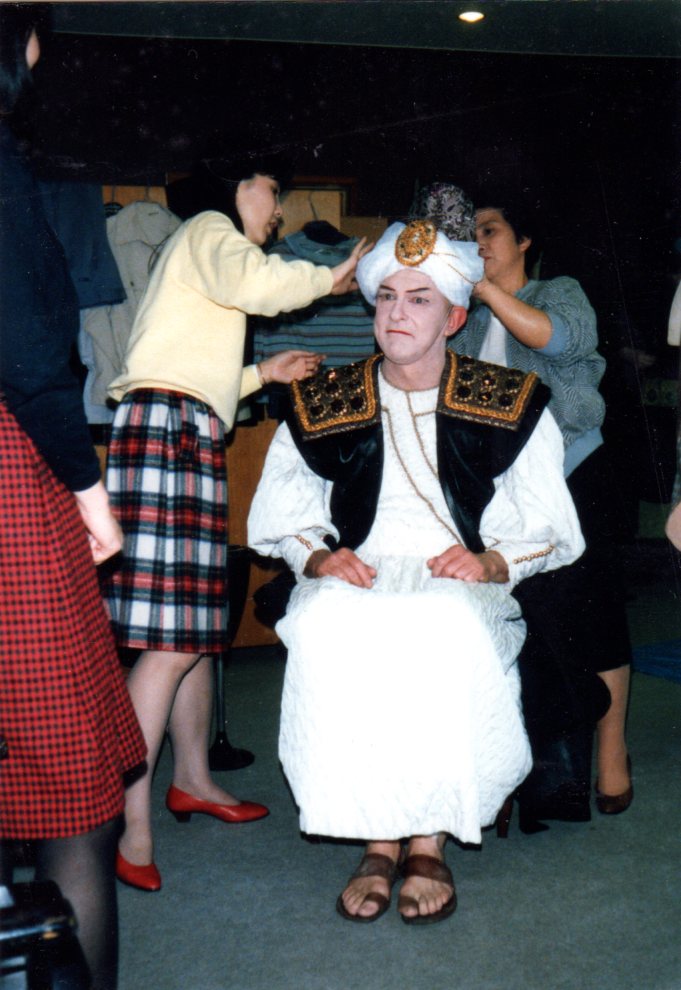
Japanese Secretaries help me with costume for parade.

            Our three years in Sasebo was a tremendous education for the whole family1.  We got to know the Japanese people and joined with them in many of their holidays, family celebrations, weddings, funerals, harvest festivals, Wisteria Viewing, Cherry Blossom Viewing, Azalea Viewing, Rose Viewing, Moon Viewing, and Kiln Opening events.
            The “Viewings” happened when the host wanted to show off his elegant gardens just as that particular blossom was at its peak, or in the case of Moon Viewings, at any full moon, but usually around harvest moon time. These events were ten per cent looking at flowers, and 90 per cent drinking sake, beer, Scotch and eating all manner of delicious Japanese food. 
            The kiln openings were held usually by master potters, but any potter could have one, and they took place when the potter wanted to show off his newest, most elegant pottery, shortly after it had come from the kiln. These also involved much sashimi, sushi, tempura, other Japanese food, and lots of sake, beer and Scotch.
            I had a Japanese civilian on my staff, Hirai-san, who was always by my side at these events, to which we were invited because I was Base Commander.  He would brief me in advance about what would happen, and what I would be expected to do.  If a speech would be required, I would prepare it in advance in English, and then Hirai-san would prepare a translation.  Sometimes I would work with him and my Japanese teacher and prepare simple remarks in Japanese. 
            My Japanese teacher, with whom I still exchange Christmas cards, was a wiry little Samurai who during World War II was assigned duty as a Kamikaze pilot, but they ran out of airplanes before he could fly one.  He is still a fascinating little guy!
            He and Hirai-san would give me the background on whatever ceremony was coming up next, and teach me some of the rudiments of what were sometimes elaborate procedures.
            Some of the rules might be considered obvious, but if disregarded they might affect Japanese-American relations at the base.  For instance, you never would take a photo of four people, and you always steered away from anything in a group of four, because “four” was the sign of death.
            Of course you would never insult Japanese customs or food, etc. or indicate that it was anything other than very desirable.  You always poured sake for others, and they were expected to pour sake for you.  The same with most drinks, and so if you as host were not attentive, your guest would get very thirsty!
            Whenever you visited someone, or attended a dinner or cocktail party, or anything, you were expected to bring a small “Omiyage” — what we would call a hostess gift.  Usually we brought something that was typically American, like a pretty towel, or some fine soap, etc.   This is a wonderful custom, and we still do it today, as do most people in our social world.
            People of Kyushu, the large island south of Honshu, where Sasebo is located, are kind of like Texans.  A “Kyushu Donji” is a manly man, they say.  When a Kyushu Donji comes home from a hard day at work, he expects to have his wife come running with his slippers and a drink.  When he needs a beer, he need only grunt “Oiii!!” and the loving Okusan will race in with a cold one for him.
            Even Japan seems to be changing, and Japanese women are starting to take apart this idea of Male Mastery, even in Kyushu, I am told.
            Our residence, or quarters, had been the quarters of the Commander of the Imperial Japanese Navy Shipyard before and during World War II. One thing that mystified us was when we would hold a large event at our quarters was some Japanese people might come an hour early. In all our years of entertaining, we never were ready to receive guests an hour early.  We greeted this nice couple and asked them to take a seat in our living room, while we and our maid and hired staff would continue scurrying around getting ready.
            They would just sit there, not talking, and pretending as if they didn’t see all the scurrying.  Then, at the appointed hour, they would rise and come to life, like they had just arrived.  That was strange for us, but our counterparts in the Embassy in Tokyo said that happened all the time, because traffic was so unreliable there, and Japanese are very prompt.
Samurai Warrior Marching through downtown Sasebo with the Mayor

            Once a year Sasebo would have a huge harvest festival, and the Base Commander would be expected to join the Mayor and other city dignitaries in dressing up in elaborate costumes as a Japanese Samurai warrior, or a mythological or historical figure.
            One year I was dressed as Momotaro, or “the Peach Boy”, from a popular Japanese legend about a boy who comes to earth in the pit of a peach.  A childless old woman and her husband discover the peach and start to eat it, when the boy tells them he was sent from heaven to be their son. 
            They raised him, and he went on to do many heroic deeds.
            We would march through town in a parade, and greet the Japanese public all along the route. I was often the only foreigner in the parade, and since I walked side by side with the Mayor, Mr. Kakehashi, everyone welcomed me. 
  
Our son Mark spent seven years in Japan, including the three years we lived there. After he graduated from American University in Washington, he returned to Japan and got a job as a reporter for Japan Times, and then became head of an English Language School in Tokyo. He became fluent in Japanese and enjoyed traveling all over East Asia.

 Next week I will tell about my experience with Japanese Firemen, and the excitement of meeting two huge American Sumo Wrestlers....

MORE ON JAPANESE CULTURE BY THE BUSHEL NEXT WEEK….


Now for some of the Personal Navigator’s Books and Newspapers….

Japan Pocket Guide, 1955  Tokyo, Japan: Japan Travel Bureau. "Japan is the land of color, charm and courtesy where the East blends with the West and the old with the new." Black and white photos of tourist attractions, maps and brief descriptions of tourist destinations. Appendix provides statistics on tourist volume, Western hotels, key phrases, fares to destinations, more. 147 pp. 13 x 18.7 cm. Green cloth on board, very good. Dustjacket, shows wear, good. (7176) $16.00. Travel/Japan


 Nova Scotia: Evangeline Land, The; Book of photographs of Nova Scotia by A.L. Hardy, Photographer ca. 1900 Grand Rapids, MI: The James Bayne Co. Evangeline Land made famous by the expulsion of Acadian farmers by the British government on account of their fidelity to the French king, as immortalized by Longfellow, an American poet. Photographs of Yarmouth harbor and Main street; The Grand Hotel overlooking Bay of Fundy; Sheep washing; Annapolis Royal; Digby Bay; Bear River bridges; Port Williams; Partridge Island; Canning; Gaspereaux, Kingsport, Cape Split, Cape Blomidon, Kentville, Wolfville, King's College, Windsor, Acadia Seminary, more. ~80 pp. 22 x 17 cm. Paper booklet, closed tear (3 cm) at photo of Horton Bluff Lighthouse, very good. (7317) $40.00. Travel/Canada


Zwischen Neufundland und Kap Horn (Signal Oct. ’40)

Signal, Sonderausgabe der "Berliner  Illustrierten Zeitung" 2 Oktoberheft 1940 D Nr. 14 [in German] 1940 Berlin, Germany: Berliner Illustrierte Zeitung. Nazi Photo Magazine published 1940-45, propaganda organ widely distributed during World War II. Cover shows black & white photo of Foreign Minister Von Ribbbentrop, Italian Count Galleazzo Ciano and Japanese Ambassador Saburo Kurusu. "Der Dreier-Pakt ist unterzeichnet: Ribbentrop, Ciano und Kurusu verlassen die Reichskanslei". Lead article: " Japan im Dreimächtepakt"  several photos show "Peace-loving" Japanese troops playing with Chinese children, feeding a Chinese baby, and giving an old Chinese man a cigarette. Another photo shows Hitler, Kurusu,  Ciano, Ribbentrop, with caption, "Die Unterzeichnung des Paktes".  "Zwischen Neufundland und Kap Horn; Der britische Ausverkauf in der westlichen Hemisphäre" with full-page map of North and South America. Photo essay "Im Gespräch mit dem Reichsaußenminister; Eine Bildfolge aus dem Hauptquartier" features nine photos of Adolf Hitler. "hieraus zieht man seine Schlüsse" shows work in Aerodynamic research in wind tunnel.  "Italians Luftwaffe"  shows photos of Italian warplanes. "Auf der  Höhe der Zeit"  shows how German military doctors take care of German soldiers. One photo shows a hospital corpsman attending to a wounded soldier, another shows a soldier carrying "Lebenselixier in Flaschen" and another shows surgeons at work in operating room. Another shows pretty Krankenschwestern und freiwilligen Helferinnen des Roten Kreuzes helping recovering soldier; final picture shows recovering soldiers relaxing at Autobahn-Rasthaus am Chiemsee, with pretty nurses lounging around them.  "Mut und Haltung entscheiden-- Schulpforta: Tradition und Zukunft einer Nationpolitischen Erziehungsanstalt."  Two pages of photos of young men developing themselves-- boxing, marching in the fields, with gymnastics, swimming, studying, etc. "Umschwung in Rumänien" Part II. "Weisst Dü, wie ich wirklich bin? -- Ein junges Mädchen zeigt - wie viele Gesichter es hat" features photos of young women. 48 pp. 27 x 36 cm. Periodical, incomplete: Missing pp. 9-10. Thus, poor. (7828) $26.00. World War II/History

Das Netz der Roten Spinne (Signal, Sept. ’43)

Signal, Sonderausgabe der "Berliner  Illustrierten Zeitung" 1 September-Heft 1943 D Nr. 17 [in German] 1943 Berlin, Germany: Berliner Illustrierte Zeitung. Nazi Photo Magazine published 1940-45, propaganda organ widely distributed during World War II. Cover shows black & white photo: "Nach einer Nacht… "Signal" berichtet in diesem Heft von einer schwer bombardierten westdeutschen  Großstadt. Das Bild zeigt den zufällig anwesenden Reichsminister Speer bei Bergungsarbeiten."  "Der Seidengürtel der Madame Sillén-- Hinter den Kulissen der Gehimorganisationen der Komintern"-- Map of globe centered on Moscow, shows "Das Netz der Roten Spinne"; photo essay "Russen reiten gegen Osten" shows Soviet troops on the move. Full-page photo, "Ostfront-Jahrgang..." shows Spanish troops "in die neue spanische Infanterie-Kriegschule bei Madrid." "Heute in Spanien-- Maja und die Vermummten". "Nach einer Nacht" photo feature shows smiling Germans after their city is bombed. Propaganda message is how well they are carrying on, in spite of it all. "Am Sonntag--wenn es schön ist" photo feature shows Germans enjoying the summer: a girl on the Kettenkarussell, sunbathers at the Strand, "Tasusende von Ruder-und Segelbooten  sind jetzt die Herren auf den Berliner Seen.” 40 pp. 27 x 36 cm. Periodical, incomplete: Missing pp. 31-32. Back cover has 4 cm tear in edge. Thus, poor. (7829) $24.00. World War II/History.


Tuesday, July 5, 2011

Our Life in the World of Antiques, Part II


Marty at Camden, Maine Antiques Show
(At last year's show...)
  
            This is the second part of the story of our life in the world of antiques.  If you didn’t see the first part, you might be interested in reading it before you read this.
Link:


            Summary:  While we spent 30 years living in various places in the U.S., and in Russia, Japan, Iran and Italy, Marty was filling her brain with antiques knowledge.  Then, when I retired from the Navy, she went into action. 
            We had an antiques shop right on Main Street in downtown Rockport, and many interesting people came in to visit us, and some bought antiques.  But, alas, there were not enough sales to justify the rent, and the other expenses, so after three years, Marty closed her shop and moved her goods to Chebacco Antiques, a group shop in Essex, MA.
          Group shops have a number of different dealers and each is assigned a particular sector, or booth.  They take turns serving as salespeople, opening up the shop each morning, attending to customers all day, then tidying up and locking up at night.  Many customers are really more interested in socializing, and they can take up hours talking about antiques they have at home, or that they once had, that might be much better than something they see in the shop. They’re glad to inform you that this or that item is  “priced wayyy too high.”
Dealers in a group shop can be as unlike each other as chalk and cheese.  In this shop the leader was dear Jane, a wonderful lady, who would be quick as lightning to tell a dealer to remove something that was not antique but a reproduction.  Allowing “repros” and any fakes to slip into a shop gives the shop a lasting bad reputation.
Then there was Shirley, a sort of extra-special woman who had arranged not to shop sit, and just called in occasionally to see if anything had sold.  She seemed to look down her nose at all the other dealers, as being far less knowledgeable than she, etc., etc.
And there was Harry, a tiny little man who had bought and sold many thousands of dollars’ worth of antiques in his time.  He specialized in moving “stuff”, and never really concerned himself with “fine” antiques.  Harry had once been a young Marine in World War II, and had landed in one of the first waves at Iwo Jima.
            Essex in 1997 was a popular destination for antiques shoppers, with perhaps two dozen shops lining the streets of that village.  However, in about 2004, with road construction in the heart of town that continued for years,  business started to slow down, and the group shop closed.  Marty then moved her goods to Concord, MA, and entered Thoreauly Antiques, a group shop right on Walden Street in the center of town.
            Concord is a fascinating town.  While Marty held forth in the shop one day a week, I often spent the day exploring Concord, which seems to be filled with very bright, interested and politically involved people.  That’s the way they were on April 19, 1775, when British troops marched into town to locate a supply of weapons and ammunition that the Americans were reported to have collected. 
            I visited the Old North Bridge, where local Minutemen gathered and fired the first shots at the Redcoats that began our Revolutionary War.  From there you could walk the same route the Redcoats took as they left Concord and headed back to Lexington, and then all the way to Boston

Granddaughter Kit with Grandfather at North Bridge
(One day I showed Kit and a friend around Concord and Walden Pond)

            The Battle Road, where the Redcoats marched, with Minutemen attacking them from all sides, is now a marvelous National Historical Park, and you can walk as much of it as you want, or ride your bicycle, or jog it, from Concord to Lexington.  There’s another trail that starts in Bedford, right next door to Concord, and the two converge in Lexington, and this Minuteman trail, which is a real asphalt road, carries bikers, walkers, runners, roller skaters and people pushing baby carriages all the way to Cambridge.
            As you walk along the Battle Road, you pass memorial plaques and little American or British flags that mark the place where an American or a British soldier fell on that day in April, 1775. 
            Not only is it great exercise, but you can get drenched in American history.
            Concord is also famous as the home of Louisa May Alcott, Nathaniel Hawthorne, Ralph Waldo Emerson and Henry David Thoreau, and you can visit all their graves in the Sleepy Hollow Cemetery.  You can also visit Walden Pond and swim or hike, and walk to the site of Thoreau’s little hut that he built there in 1845.
            Many of those bright people in Concord, especially the female ones, drifted through Thoreauly Antiques.

Marty’s booth at Thoreauly in Concord.

After about two years, Marty felt like moving, so we took her whole set of antiques across the street to North Bridge Antiques, and she was there for three years.
            In between the shops and all the hours of shop-sitting, we shopped for new stock.  Usually we went to outdoor antiques markets in Nashua, Milford, Amherst and Hollis, NH.
            We also went to to lots of auctions.  We went to high end auctions, where some items went for a million dollars, and lots of low end auctions, sometimes held out under a tent, on an old farm.  A favorite still are the James Julia Auctions up in Fairfield, ME.  Julia gathers amazing, wonderful items into his barn, and although some are going for astronomical prices, there are always bargains. 
One of the interesting features of some auctions would be an old man who sits in the front row, looking very much like the typical old Maine farmer, maybe with long beard, and wearing overalls.  Although he looks like a penniless hick, he may end up filling up a large truck with things that barely reach auction reserves. There must be a bunch of these good old boys who show up at Maine and New Hampshire auctions.
            At many auctions, particularly when fine old estates are getting rid of their Persian carpets, there will be a little knot of Iranian rug merchants from all over the Boston area.  They usually gather at the back of the hall and talk loudly in Farsi, ignoring the auctioneer until the carpets come up.  When they buy, they pay for the carpets by peeling off wads of $100 bills.
            Now that we have been shopping at these markets for over 20 years, Marty has gained a whole raft of dealers who remember what she buys, and sometimes save things especially for her.
            Antiques dealers are interesting people, and some are very knowledgeable people who know a lot about the things they sell.  Some may have once worked for a large auction house like Sotheby’s, some are appraisers, and some have elite credentials, like a master’s degree in fine arts.  There are others who truly must live in depressing situations.  One look at the automobiles of some dealers gives you a clue. Not a few drive cars or vans where there is a small hole carved out for the driver to operate the vehicle.  Everything else is filled with stuff thrown in over the years, and apparently coagulated into a colorful mass.  From this they pull enough things to put on the table of their booth. 
            These people often tell you about their homes, which may include banana boxes stacked to the ceiling in every room, including dining room and living room, and lamps, books and much miscellany all over the kitchen, bathroom and bedroom. They may also store additional stock in a couple of old trailers or trucks in the yard.
            Some of these more colorful dealers appear not to have much use for showers, clean clothes or shaving.
            My favorite ephemera (or paper) dealer is a scruffy guy who lives on the side of a mountain in New Hampshire, and arrives in an ancient station wagon, brimming with interesting old railroad timetables and Victorian advertising cards, 19th century magazines and newspapers, books, license plates and antique girlie magazines.  He has an amazing eye for items by important old illustrators, can point out an 1865 newspaper with an obscure story about John Wilkes Booth, or show you an old copy of Atlantic in which Edgar Allan Poe published his first short story.
            Then there are buyers, most of whom are polite and agreeable.  But there are a few who give the impression that if they cannot buy this item their world will end.  They have to have it, and heaven help you if you also have an interest in buying it. These are the super aggressive ones, and they are rude, pushy and obnoxious.
            You see these pushy people again at the start of antique shows where we are set up.  These shows are usually in rather elite locations, where the typical customer is well-dressed and well-mannered.  But these people swoop in, eyes darting like a snake’s.  You greet them, but they don’t answer, because all their sensors are looking for the next prize.  Often you are just putting your booth together, still removing things from storage boxes when they hit, but if they see something they want, they ask its price, and then seem offended when you won’t let them have it for one-third of that amount. 
            Perhaps the worst of this beady-eyed lot of early shoppers are the silver and gold buyers.  These men have no eye for beauty.  If they find a piece of the most delicately fashioned piece of Sterling, and they feel that they can sell it for scrap to be melted, they’ll pull out their tiny scale and weigh it right there.  Never mind if it is a silver mirror once used by Marie Antoinette, they’d take it to the smelter! 
            Another creature often shows up when you are doing shows, or in your shop, and this is the lonesome soul who can consume hour after hour of your time, even if you are trying to serve real customers.  One, a young man, has an endless reel of stories to tell you about his profession as a statistician.  He has worked on space projects, ship construction, secret government projects, tells about designing a miniature house in which he now lives; he knows about flying saucers, and has complex theories for solving world hunger.  When you see him coming, you try to look very busy!

            We’re doing our next show Saturday, August 6th in Little Compton, RI at the Sakonnet Vineyards at 162 W. Main St.  It’s a very nice show, with a Preview Party Friday, Aug. 5th from 6 to 8 p.m.
http://www.ferguson-darruda.com/

Antiques—buying, cleaning, repairing, polishing, researching and selling—it’s been a wonderfully educational experience.  Each new acquisition offers a chance to look into another corner of someone’s world of a day gone by. 
            Marty stood by my side, and helped me all during my naval career.  Now it’s a pleasure to be her chief schlepper* and assistant salesperson!

*[Yiddish for one who lugs, hauls something with difficulty.]  

Antique Chinese leather boxes

Now, about those books and papers:

Child care, 1913 style:
Care and Feeding of Children, The; by L. Emmett Holt, M.D., LL.D., Professor of Diseases of Children at Columbia University, Sixth Edition, Revised and Enlarged. 1913 New York, NY: D. Appleton & Co. Author's aim is not to alarm the mother by acquainting her with all the possible diseases and accidents which may befall her child, but to open her eyes to matters which are direct and chief concern. Care of children: bathing, genital organs, eyes, mouth; cover chest with soft flannel band. Napkins (diapers) which have only been wet may be used for a second time without washing, unless there is chafing. Airing the nursery. When to take a baby out for an airing.  Infant feeding. Mothers who have had tuberculosis should not nurse their babies. Weaning children from the breast; from the bottle. Modification of cow's milk.  Common mistakes in milk modification. Kissing infants  -- tuberculosis, diphtheria, syphilis and many other grave diseases may be communicated in this way.  Colic, Earache. Croup. Convulsions. Rubella. Scarlet fever. Chicken-pox. Mumps.  Scurvy. Constipation. Diarrhœa. 212 pp. 12 x 17 cm. Olive green cloth on board with gilt lettering, minor rubbing, very good. (5250) $17.00.  Women's/Child care

All about women in the 1880s…
Daughters of America; or,  Women of the Century, Illustrated  by Hanaford, Phebe A. ca. 1883 Augusta, ME: True and Company. Marvelous copy of a grand celebration of and for women; Dedicated to the women of future centuries of the USA. Author Phebe Ann Coffin Hanaford (b. 1829— d. 1921) was a lifelong pioneer of feminism, abolition and women's suffrage.  Frontispiece steel engraving of Phebe Hanaford. Stories and illustrations of famous women include Hannah Duston, Martha Washington, Lucretia Mott, Phoebe Cary, Alice Cary, Ida Lewis, Miss Frances E. Willard, Mrs. Sarah K. Bolton, Mrs. R.B. Hayes, Mrs. Dr. McCabe, Mrs. Mary T. Burt, Elizabeth Comstock, Mother Taylor, Emily Huntington Miller, Mrs. Mary C. Johnson. Chapters devoted to  women leaders in many fields; women during the Civil War, wives of Presidents, literary women, women poets, women scientists, women reformers, women preachers (including Mrs. Hanaford), women missionaries, more. 730 pp. 14 x 22 cm. Elegant copy  with fresh decorated cover in muted gold, with image of Martha Washington, slight edge wear on heel and toe of spine. Gilt-edged pages, quite bright and clean. Very faint foxing on frontispiece. Handwritten inscription from "Aunt Fannie" to Elva on front free endpaper, dated 1893.  Very good. (1674)  $66.00. Women's/Biography

"Oh, I am so nervous! No one ever suffered as I do!”—Ad for Lydia Pinkham’s…
Delineator, The; A Journal of Fashion, Culture and Fine Arts, March, 1896, Vol.  XLVII No. 3 New York, NY: Butterick Publishing Co. Excellent collection of women's, girls' and children's styles for 1896; little boys in skirts; many good ads. Lydia E. Pinkham's Vegetable Compound adv.:
"Oh, I am so nervous! No one ever suffered as I do! There isn't a well inch in my whole body! I honestly think my lungs are diseased, my chest pains me so; but I've no cough. I'm so weak at my stomach and have indigestion horribly. Then I have palpitation and my heart hurts me. How I am losing flesh! and this headache nearly kills me; and the backache! --why I had hysterics yesterday!... there are the pains in my groin and things. I can't sleep, walk or sit. I'm diseased all over.  The doctor? Oh! he tells me to keep quiet." 156 pp. 20 x 28 cm. Paper periodical, good. (5107) $35.00. Women's 

Commentary on the European Revolutionary Epidemic, Catholics, Abolitionists…
Ladies' Repository for 1850, The, Rev. B.F. Tefft, D.D., Editor 1850 Cincinnati, OH: L. Swormstedt & J.H. Power.  Splendid collection of elegant engravings, poetry, music, religious thoughts, travel, all manner of literature, book reviews, commentary, attacks on "corrupting literature."  Impressive array of reading for educated women: Lead article for February discusses three books on The Jesuits, gives a colorful description and discussion, but ends with a stern message against the "Romish denomination."  An Incident of the Hungarian War. Adulation of Kossuth. "Tracks of a Traveler" for September relates journey from Canada to Syracuse to Albany and eventually to Martha's Vineyard and Boston, MA. In Boston, editor attends wild meeting of the "radical, abolition, non-resistant, woman's rights, anti-Church, no-government, general-reform, out-and-out, come-out, Garrisonian Society of Fanatics. Never since the flood, has there been such a congregation of lunatics, as were assembled."  Report from Germany on new strides in women's equality. 412 pp. 16 x 25 cm. Red leather on board, moderate edge wear, engravings and some pages foxed, very good. (4821) $60.00. Women's/Religious/Travel/Poetry/Literature

Teaching Women how to handle the Law…
Laws of Business for All the States of the Union with forms and directions for all transactions, Revised Edition by Parsons, Theophilus, LL.D 1875, Hartford, CT: S.S. Scranton & Company. Harvard Law Professor prepared this book for everyman.  Mortgages of land, goods, chattels; rights of women (very few); Bankruptcy; Notes of Hand and Bills of Exchange; Infants or minors; Apprentices. Married Women: …" a married woman is wholly incapable of entering into mercantile contracts on her own account. By the fact of marriage, her husband becomes possessed of all her real estate during her life, and if a living child be born of the marriage, he has her real estate during his own life, if he survive her."  Includes laws of each state with regard to Married Women.   697 pp. 14 x 23 cm. Maroon cloth on board with calf spine, edges frayed, leather quite scuffed; inside hinges cracked; owner name dated 1875 on ffep. Good. (4818) $30.00. Reference

More on Lydia Pinkham’s Medicine for Women…
Lydia E. Pinkham's Private Text-Book, Revised Edition ca. 1930 Lynn, MA: The Lydia E. Pinkham Medicine Co. In front of book: Caution to the owner:  This little book treats of  delicate subjects and has been sent to you only by request. It is not intended for indiscriminate reading but for you own private information. Book teaches women about menstruation and women's illnesses, and care, including Lydia E. Pinkham's medicines. Also includes very explicit testimonials, two blank postcards addressed to LEP Co., and an offer for a hot plate rest. 63 pp. 11.5 x 15.5 cm. Paper booklet with tape spine, very good. Included are testimonials for Sanative Wash, two blank postcards, and a typed letter offer. (5555) $30.00. Women's/Medical/Advertising