Wednesday, February 22, 2023


Thursday, December 1, 2022
India from Colony to Major World Actor
Rockport History Book Club
India from British Colony
To Major World Actor
History Book Club
Wednesday, November 30,
2022

Gandhi led 1947 fight for Indian independence
Wednesday, November
30, 2022: India from British Colony to Major World Actor.
Read about how, after World War II ended Mahatma Gandhi led
the fight for India’s independence; then came separation of Hindu India and
Muslim East and West Pakistan; then East Pakistan became Bangladesh and India
and Pakistan went to war. Read about how America’s presidents looked down their
noses at India as it became an ally of the USSR; development of nuclear power;
now read about relations with China, and India’s growing influence in the
world, including the U.S. [Suggested by Craig
Corvo]
Roberts, Elizabeth Mauchline, Gandhi,
Nehru and Modern India, Methuen Educational Ltd. 1974. 96 pp.
Ms.
Roberts focuses her story on a wisp of a little man with big ears and wearing a
white cloth wrap who turned out to be the hero for modern India.
Mohandas
Karamchand Gandhi was born in Porbandar, Gujarat on Oct. 2, 1869 to a Hindu
family that was not wealthy, but never suffered from the terrible poverty of
most Indians. His father and grandfather had been prime ministers of various little
states on the Kathiawar peninsula on the Arabian sea, north of Mumbai.
Mohan
started school at age five. He was an average student. At age 13 he married Kasturbai, a girl chosen
by his parents. It was a marriage that lasted 61 years. When he graduated from
high school, his family decided he needed to go to England to become a
lawyer. After three years he returned to
India, then was sent to practice in South Africa. He suffered racial prejudice
terribly there, but he soon learned to practice satyagraha (truth force) that
he would teach all his life. In 1896 he took a quick trip home and brought
Kasturbai and his two sons back to South Africa. He practiced there until 1915.
Gandhi
was shy, but he developed a mystical ability to lead people, no matter what
their caste, color or wealth. He grew the Natal Indian Congress to an effective
minority party. The South African government declared all Indian marriages
invalid, and Gandhi organized Indian women to protest, which led to beatings,
prison and even death. Gandhi was
briefly imprisoned, but all the while he was developing his satyagraha, and
becoming a force to be reckoned with.
In 1885 an
Englishman recently retired from the Indian Civil Service created the Indian
National Congress, a non-political group of mostly journalists or lawyers,
intended to praise the contributions made to India by the English. In 1905 the
congress got involved with a national movement to preserve the Bengal from
partitioning. When Gandhi and his family, (now with four boys) returned to
India in 1915, he still had a great deal of respect for Britain as a colonial
ruler of India. The year 1917, as thousands of Indians and other British
colonials fought for the King against Germany, was the high point for
colonialism in India. From there on to
swaraj (home rule) in 1947, it was all downhill.
Gandhi created a
sort of satyagraha ashram, or community near Admedabad, near his old birthplace
in Gujarat, and Indians came from far and near to enlist his help in righting
the wrongs of millions of desperately poor Indians.
During WWI there
were terrorist bombings in Punjab as some objected to British recruitment
practices, and in 1918 the worldwide flu
epidemic killed 13 million Indians. The British were giving some measures to
placate the Indian population with a suggested goal of eventual home rule.
Trouble in
Punjab was just starting. On April 13. 1919 the British General in charge had
his troops fire on a crowd of Indians crowded into Jallianwala Bagh and killed
379 and wounded 1200. This became known as the massacre at Amritsar, and it
became the beginning of the end for British rule in India.
Amritsar marked
the beginning of Gandhi’s leadership in the Congress party, which he kept for
the next 28 years, until independence in 1947.
Gandhi was assassinated by a
Hindu fanatic on Jan. 30, 1948 in Delhi.
-end-
2022-2023
THERE
WILL BE NO MEETING IN DECEMBER.
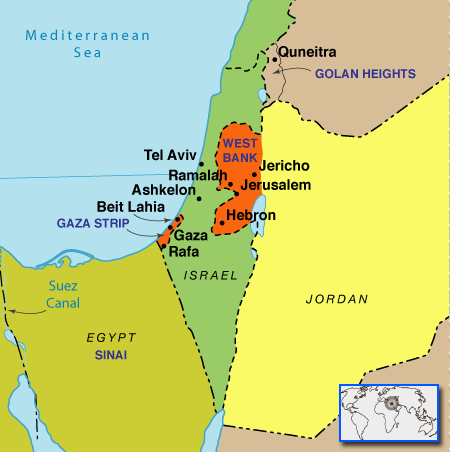
Wednesday, January 25, 2023: What will it take to have peace between Palestinians and Israelis? It started as “The Land of Milk and Honey” 6000 years ago. Then there were the crusades. Centuries of mistreatment and exclusion of the Jews; the pogroms; the Holocaust which killed six million Jews in World War II; There was the United Nations General Assembly partitioning of November 1947; The creation of Israel, in 1948; The Six-day War of 1967 which resulted in huge loss of territory by the Arabs; And there were the meetings at Camp David hosted by President Carter with Anwar Sadat and Menachem Begin; The Palestinians have steadfastly opposed any plan that gives them land, including part of Jerusalem, most of the West Bank, etc., as long as the Jews are still around. What will it take? Read any book on this subject. [Suggested by Craig Corvo and William Tobin.]

Wednesday, February 22,
2023: Are We Facing Fascism in America? The
term "Fascism" was first used in 1915 by members of Benito Mussolini's
movement, “The Fasces of Revolutionary Action.” Mussolini declared that it was
necessary for Europe to resolve its national problems—including national
borders—of Italy and elsewhere “for the ideals of justice and liberty.” It
molded itself to appeal to Italian conservatives, accepting the Catholic Church and the monarchy as
institutions in Italy. Fascism adopted policies such as promoting family
values, including policies designed to reduce the number of women in the
workforce—limiting the woman's role to that of a mother. They banned literature
on birth control and increased penalties for abortion in 1926, declaring both
crimes against the state. It aimed to appeal to people upset with the new
trends in sexuality and women's rights. The Fascists supported revolutionary
action and committed to secure law and order, with aspirations of
totalitarianism. [Proposed by Ellen Canavan and Sam Coulbourn]

Bread and Roses Strike, Lawrence,
1912
Wednesday, March 29, 2023: Insurrections, Strikes and Riots that Shaped American
History. Our
history is peppered with uprisings, large and small. Read about some and show
how they affected life and our laws. For instance: Shay’s Rebellion,
1786– 1787), uprising in western Massachusetts in opposition to high taxes and stringent economic conditions. The Whiskey
Rebellion (also known as the Whiskey Insurrection) was a
violent tax protest in the
United States (1791-1794) during the presidency
of George Washington. The most violent and widespread insurrection
was the Civil War. The Lawrence Textile Strike, also known
as the Bread and Roses Strike, was a strike of immigrant workers in
Lawrence, Massachusetts, in 1912 led by the Industrial Workers of the World
(IWW). In Boston we had the
1919 Boston Police Strike. Also, scores of riots like the 1885
anti-Chinese riot in Wyoming, the anti-Greek riot in Omaha, 1909; the
1921 Anti-Black riot and destruction in Tulsa, and the 1968 riots after
Martin Luther King was assassinated. [Proposed by Mary Beth Smith
and Bill Tobin].
Wednesday, April 26, 2023: Japan from Meiji to WWII: What were they
thinking?
The beginning of the Meiji Era in 1868 marked the introduction of
a secretive, closed world to the world. Soon Japan joined the industrial era,
modernized government and society and became a modern nation, building an armed
force that fought China and won in 1894,
defeated the Russian fleet in 1905, joined the allies against Germany in World
War I, had the third largest navy in the world by 1920, and attacked the United
States, Great Britain, France, and the Netherlands and joined the Axis in World
War II. Read about the dazzling rise of Japan up to its defeat. Read any book
about this history.
What led to it? Examine all or part of the rapid change of a
country closed off from the world, then the Black Ships of Commodore Perry and
the rapid entry of Japan to the world and the world to Japan. [Proposed by
Sam Coulbourn]
Wednesday, May 31, 2023: Presidents
who redefined the presidency and shaped the United States. Here is
your chance, based upon your reading about American presidents, to tell us your
choice for a president who made a difference in growing the country:
Sunday, July 24, 2022
Game-changing Maritime Inventions
Game-changing Maritime Inventions
History Book Club
Wednesday, July 27, 2022

Wednesday, July 27, 2022. Game changing maritime inventions. Read about the days of ships propelled by sail, oars, coal or oil, paddle wheelers, steam engines, or warships like dreadnought, submarines, aircraft carriers, or torpedoes, propellers, chronometers, sextants, etc. [Proposed by Janos Posfai]
James E.
Bradford, Editor, America, Sea Power and the World, Chichester,
UK: John Wiley & Sons, Ltd.; 2016.
Herman Kahn, On
Thermonuclear War, Princeton, NJ: Princeton University Press, 1960.
I’ve been involved with maritime
inventions ever since I arrived at the Naval Academy as a 19-year-old in an
ill-fitting light blue suit. I arrived in 1953, and at that time the U.S. Navy
was starting to build a massive nuclear submarine force.
Captain Hyman Rickover was an
irritable, ornery engineering duty officer who was behind the creation of our
nuclear navy. He single-handedly pushed
and shoved and agitated the admirals of the Navy and members of Congress to develop
nuclear power plants for submarines. He had loads of opposition—the very idea
of squeezing fissionable material into a core that would heat water used to
drive turbines to propel a submarine scared the daylights out of most senior
officers in the Navy.
However, senior officers had looked
askance at ships substituting steam power for sails. They doubted the
effectiveness of heavily armored battleships. Except for naval aviators, they
looked at aircraft carriers as sitting ducks for enemy guns. The senior
leadership of the Navy most often was too “dug in” to status quo, so they rejected
new ideas.
The Navy experimented with submarine
power plants using liquid sodium, as well as water. Water won out. Rickover pushed and soon USS Nautilus
became a reality. Men who had served on
submarines all during World War II had great misgivings about nuclear-powered
submarines, even after some of them took command of the first nuclear
submarines.
Rickover was a perfectionist. Not a team player. He was brilliant, and he
eventually got his way. Senior officers
in the Navy disliked and distrusted him, and his ability to work the Congress
to obtain the money for each step toward a nuclear Navy.
I was serving on my first submarine,
a World War II submarine in New London, CT, when I was ordered to Washington to
see the “Kindly Old Gentleman” as we jokingly called Rickover.
I got the standard treatment: sitting
in a small room full of books, waiting my turn to see the Admiral. The Navy
had, with pressure from his supporters in Congress, promoted Rickover. Finally,
I went into his office and sat in a chair with the front legs shortened, so you
felt like you would slide out of the chair.
All part of the “treatment”.
He noted my academy academic record
and observed that math and science were not my best subjects. He kicked me out, and ordered me to go back
to my submarine and study, and if I was up to it, come back to see him in a
year. I tried reading nuclear physics text books in my spare time, but for a
young officer aboard a submarine, there wasn’t any spare time.
A year later I received orders for
training to go aboard a Polaris submarine as weapons officer. This meant I
would focus on handling 16 missiles with thermonuclear warheads, and other
officers would worry about Rickover and the power plant.
The idea of putting intercontinental
ballistic missiles aboard a submarine was not an easy idea for the Navy, or
Congress, to handle. The idea of a
missile in a nuclear submarine accidentally exploding conjured the image of a catastrophic
nuclear event, with both power plant and weapon.
President
Eisenhower wrestled with this first, as we faced the Soviet Union, which was
rapidly building a missile force capable of demolishing many American cities.
By the time John F. Kennedy relived him, the first Polaris submarines were built
and about to go on patrol.
In 1962 I had
spent the Cuban Missile Crisis as a submariner on a battle staff set up in
Argentia, Newfoundland. We were flying antisubmarine
warfare planes from there, Iceland and the UK, and coordinating with American
submarines patrolling all down the Atlantic, to oppose the Red Fleet surface
warships and submarines that we expected would
burst out of Soviet far northern bases and head to Cuba.

USS Ethan Allen (SSBN608)
A year later I was on my first patrol, in
charge of the weapons department aboard USS Ethan Allen, Gold Crew. The Blue crew brought the ship in, and then
our crew spent nearly a month in port in Holy Loch, Scotland, getting ready for
the next patrol. Then we went out for a couple of days of sea trials near Northern
Island. Finally, we sailed, submerged all
the way, to the Mediterranean, and headed east near the coast of Lebanon and
Israel.
As we were en route to our patrol area
we were busy with all the tests on our weapons, and standing watches. In spare moments I read Herman Kahn’s On
Thermonuclear War, which was his idea of the concept of “MAD” or
mutually assured destruction. Years later, serving as Naval Attaché in the
USSR, I learned that Soviet naval officers had been reading Kahn’s book, as
well.
Now we were carrying missiles as
close as we could get in the Mediterranean, aimed at Soviet targets. Part of the Cuban agreement between Kennedy
and Khrushchev had been to give up our Jupiter missiles in Turkey. We were covering those targets in the USSR.
On Thermonuclear War gave us
all something serious to think about. We believed that if we had to shoot those
missiles, we’d wipe out major Soviet cities.
And the Soviets would wipe out some of ours.
I’m happy to report, as you well
know, that we didn’t use those weapons. Yet.
--Sam Coulbourn
-end-
2022-2023

Wednesday, August 31, 2022. How Should We Deal with China? Let's dig into the history of China and try to learn how
the United States should approach China, in terms of human rights, trade
policy, Taiwan, Hong Kong, Global Warming, Nuclear Weapon Proliferation,
autonomous weapons, public health, and much more. We are tremendously
interdependent: should we continue to view China as an Opponent? [Proposed
by Walt Frederick]

Ethel
and Julius Rosenberg
Wednesday, September 28,
2022. Trials of historical
significance. Read about the Nuremberg War Crimes Trials (1945-46), or the Trial of
Julius and Ethel Rosenberg (1951), Burning of the Reichstag trial (1933), or
the Trial of Galileo
Galilei (1633), Martin Luther and
the Diet of Worms, (1521) (not what it sounds like), the Trial and Death of
Socrates by Plato (399 BC), or many more. [Proposed
by Janos Posfai]
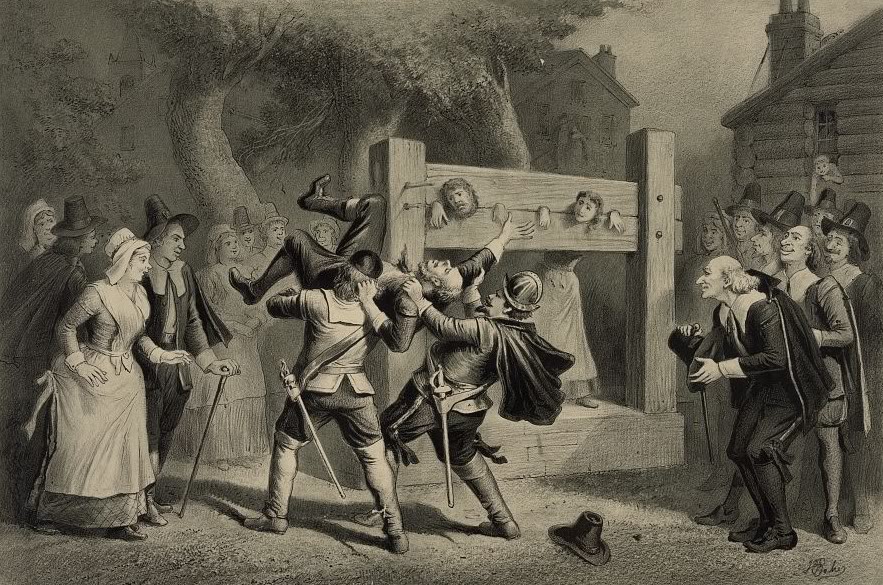
Salem Witch Trials
Wednesday, October 26, 2022. Religion and Politics in
America. Religious impact in American
political events. E.g.: Influence of fundamentalist and Catholic churches on
Supreme Court decisions, Puritan Exceptionalism, justification of slavery
through the Bible, Abolition Movement, treatment of Native American
Christianization movement, Justification of Imperialism’s Christianization
mission, Father Coughlin vs. Franklin Roosevelt, Cotton Mather and the Salem
Witch Trials. [Suggested by William Tobin]

Wednesday, November
30, 2022: India from British Colony to Major World Actor.
Read about how,
after World War II ended Mahatma Gandhi led the fight for India’s independence;
then came separation of Hindu India and Muslim East and West Pakistan; then
East Pakistan became Bangladesh and India and Pakistan went to war. Read about
how America’s presidents looked down their noses at India as it became an ally
of the USSR; development of nuclear weapons; now read about relations with
China, and India’s growing influence in the world, including the U.S. [Suggested by Craig Corvo]
THERE WILL BE NO MEETING IN DECEMBER.

Wednesday, January 25, 2023: What will it take to have peace between
Palestinians and Israelis? It started as “The Land of Milk and Honey”
6000 years ago. Then there were the crusades. Centuries of mistreatment and
exclusion of the Jews; the pogroms; the Holocaust which killed six million Jews
in World War II; There was the United Nations General Assembly
partitioning of November 1947; The creation of Israel, in 1948; The Six-day War
of 1967 which resulted in huge loss of territory by the Arabs; And there were
the meetings at Camp David hosted by President Carter with Anwar Sadat and
Menachem Begin; The Palestinians have steadfastly opposed any plan that gives
them land, including part of Jerusalem, most of the West Bank, etc., as long as
the Jews are still around. What will it
take? Read any book on this subject.
[Suggested by Craig Corvo and William Tobin.]
Friday, June 24, 2022
Assassination and Execution of Leaders
Assassination and Execution of Leaders
History Book Club
Wednesday, June 29, 2022

Mohammad Anwar el-Sadat
محمد انور السادات
Wednesday, June
29, 2022. Assassinations and executions
of leaders. Read the stories of how
famous people were assassinated and what came after. From modern times--- Anwar
Sadat, Olaf Palme, Yitzhak Rabin, Aldo Moro, Mahatma Gandhi, Indira Gandhi, or
Presidents Lincoln, Garfield, McKinley, and Kennedy, or Franz Ferdinand, King
of Albania, Nicholas II of Russia, or earlier-- Henry VI, James III, Henry III,
Julius Caesar. [Proposed by Janos Posfai]
Charles River
Editors, Anwar Sadat : The Life and Legacy of the Egyptian President,
2015, Audiobook.
This was my first occasion to “read”
a book by audiobook, and it was challenging.
I was unable to make yellow underlining of text in a Kindle book, and that
meant I scribbled many notes.
Anwar started life in 1918, born in
a village to working class parents. He
found his way to join the Egyptian army and began a career that eventually made
him one of the most consequential leaders in the Middle East.
Sadat graduated from the Egyptian
military academy in 1938, and early in his career he worked to get rid of the British
occupation. He formed the “Free Officers’ Association”
to work toward creation of a free Egypt.
Egypt had been under British occupation for years, and there was much
unrest. His first attempt at revolution
was a failure and the British threw him into prison in 1941, as war was
spreading across the world.
Another leader of Egypt under
British rule, Ahmed Pasha, was assassinated in 1946, and Sadat got thrown in
prison again for that.
He made friends with a fellow
officer, Gamal Abdel Nasser, and they worked together with others toward
eventually driving out the British and overthrowing the puppet leader, King
Farouk, on July 23, 1952. This marked the start of Egyptian sovereignty, and
Gamal Abdel Nasser became leader.
Nasser grew more and more under
Soviet influence. The six-day war of 1967
was a stinging defeat for Egypt. Nasser was growing old before his time, and
died on Sept. 28, 1971, of heart attack, with much speculation that he had been
killed by the Soviets, the Americans, or the Israelis.
Sadat was vice president, so he
became acting president. No one
considered him a serious leader. He’d
long been called “Nasser’s black poodle”, alluding to his Nubian (black)
ancestry.
Nasser had encouraged the country’s alliance
with the USSR, even though many thought that the Soviets treated Egyptians
poorly. Sadat saw them as worse than the British, who characteristically had
treated all Arabs with disdain. In 1972 Sadat had had it with the Russians and
he ordered them all to leave. This came
as a surprise to the Americans, as he had not confided in them or sought their
support. The Americans under President
Nixon apparently were slow to see this as an opening.
In 1973 Sadat started the Yom Kippur
War against Israel, and the Arabs lost again, but Sadat claimed he “went to war
to make peace.” I had just taken command of a new ammunition ship, and just
before we departed for the Middle East the war broke out and the Pentagon
ordered us to load up with cluster bombs.
Our carriers in the Med had given the Israelis their cluster bombs,
which are deadly in attacking troop formations.
We sailed for the Med with our decks and magazines stuffed with cluster
bombs, as well as our regular ammunition. We re-supplied the American
carriers. These bombs were banned in
2008 but the Russians were known to have used them this year in Ukraine against
civilians.
In his early years it was clear that
Sadat was smart, and got along well with his contemporaries, but unlike his
friend Nasser, he wasn’t self-centered and eager to get to the top. Now that he
was at the top in Egypt, he showed his ability.
In November 1977 a Soviet-American
plan for peace in the Middle East fell apart, and Sadat went to the Egyptian
parliament and declared his willingness to go to Israel to discuss peace. He worked with the Americans, and Israel’s
Menachem Begin invited him to visit. On
November 19, 1977, Sadat landed in Jerusalem and was met by Begin. He addressed
the Knesset, and the two leaders began a process which, under the auspices of
President Jimmy Carter, in meetings with Begin and Carter in the U.S. resulted
in the Camp David Accords on September 17, 1978.
Sadat made a move that marked him as
a prince among leaders in the Arab world when he committed to seek peace with
Israel. It was an earth-shaking event
that was met with celebration in Egypt and delight in Israel, but disgust and
hatred in most Arab nations. Egypt was expelled from the Arab League. Islamist
factions in Egypt hated it, too.
Sadat and Begin were awarded the
Nobel Peace Prize, but the Arab world, including Egypt’s Islamic Jihad, were
furious. And so were the Soviets, who had nurtured support for the Arab world
as the U.S. had lined up on the side of Israel,
with the Shah of Iran and Saudi Arabia.
The Shah was kicked out of Iran in 1979 as Ayatollah Ruhollah Khomeini began the Islamic Republic of Iran. Americans left Iran in droves. The Soviets began their invasion of Afghanistan. Although Sadat enjoyed support and admiration in Egypt, Islamists were on the rise, and the Soviets were right there to offer help.
The last few months of Sadat’s presidency were plagued by internal uprisings. Sadat believed that the revolts were instigated by the USSR recruiting regional allies in Libya and Syria to incite a coup. In February 1981, Sadat learned of a plan to depose him. He responded by arresting 1,500 of his political opposition, Jihad members, Coptic clergy, intellectuals, and activists. He banned all non-government press.
The widespread
arrests missed a Jihad cell in the military, led by Lieutenant Khalid
Islambouli.

Sadat Assassination, Oct. 6, 1981
On October 6, 1981 Sadat attended a parade
in commemoration of the eighth anniversary of Egypt's crossing of the Suez Canal during the Yom Kippur War. Men atop
one armored personnel carrier saluted Sadat and he stood to return the salute,
but then men jumped down and Islambouli threw grenades at Sadat and four others
began shooting at him and other spectators in the stands. Sadat was mortally wounded, ten others were
killed, and 28 others were wounded, including Vice President Hosni Mubarak.
Islambouli and the other assassins
were tried, found guilty, and sentenced to death. They were executed on April 15, 1982.
Sadat
was buried in Cairo. The inscription on his grave
reads: "The hero of war and peace". Three former U.S. Presidents (Richard Nixon, Gerald Ford and Jimmy Carter) as well as Israeli Prime Minister Menachem Begin, and leaders from France, West Germany, Italy, Ireland, Spain and Belgium attended.
Mohammad Hosni Mubarak became president and served until the Arab Spring uprisings in 2011, (1981-2011) 29 years. His presidency was marked by a continuation of the policies pursued by Sadat. This included the liberalization of Egypt's economy and a commitment to the 1979 Camp David Accords. Under Mubarak Egypt re-united with the other member states of the Arab League, and worked with the U.S., USSR, and much of the west. However, international non-governmental organizations criticized his administration's human rights record.
-end-
2022-2023

Wednesday,
July 27, 2022. Game changing maritime inventions. Read about the days of ships propelled by sail, oars,
coal or oil, paddle wheelers, steam engines, or warships like dreadnought,
submarines, aircraft carriers, or torpedoes, propellers, chronometers,
sextants, etc. [Proposed by Janos Posfai]


Wednesday, August 31,
2022. How Should We Deal with
China? Let's dig into the
history of China and try to learn how the United States should approach China,
in terms of human rights, trade policy, Taiwan, Hong Kong, Global Warming,
Nuclear Weapon Proliferation, autonomous weapons, public health, and much
more. We are tremendously interdependent: should we continue to view
China as an Opponent? [Proposed by Walt Frederick]


Ethel
and Julius Rosenberg
Wednesday, September 28,
2022. Trials of historical
significance. Read about the Nuremberg War Crimes Trials (1945-46), or the Trial of
Julius and Ethel Rosenberg (1951), Burning of the Reichstag trial (1933), or
the Trial of Galileo
Galilei (1633), Martin Luther and
the Diet of Worms, (1521) (not what it sounds like), the Trial and Death of
Socrates by Plato (399 BC), or many more. [Proposed
by Janos Posfai]

Cotton Mather and the Salem Witch Trials
Wednesday, October 26, 2022. Religion and Politics in
America. Religious impact in American
political events. E.g.: Influence of fundamentalist and Catholic churches on
Supreme Court decisions, Puritan Exceptionalism, justification of slavery
through the Bible, Abolition Movement, treatment of Native American Christianization
movement, Justification of Imperialism’s Christianization mission, Father Coughlin
vs. Franklin Roosevelt, Cotton Mather and the Salem Witch Trials. [Suggested
by William Tobin]

Wednesday, November 30, 2022: History of English/British Colonialism It started in the latter part of the 15th Century with plantations in Ireland. Read how the United Kingdom grew to become the greatest Empire in the history of the world. If you wish, home in on British slave trade, and how the U.K. colonized the New World, bringing slaves to grow sugar and cotton. Or Napoleonic Wars and Britain’s seizure of French Colonies. America and Canada. Colonization of Asia in Hong Kong, Malaya, Australia, New Zealand, India, Burma. Africa, and more for you to discover. [Suggested by Craig Corvo]
THERE WILL NO MEETING IN DECEMBER

Wednesday, January 25, 2023: What will it take to have peace between Palestinians and Israelis? It started as “The Land of Milk and Honey” 6000 years ago. Then there were the crusades. Centuries of mistreatment and exclusion of the Jews; the pogroms; the Holocaust which killed six million Jews in World War II; There was the United Nations General Assembly partitioning of November 1947; The creation of Israel, in 1948; The Six-day War of 1967 which resulted in huge loss of territory by the Arabs; And there were the meetings at Camp David hosted by President Carter with Anwar Sadat and Menachem Begin; The Palestinians have steadfastly opposed any plan that gives them land, including part of Jerusalem, most of the West Bank, etc., as long as the Jews are still around. What will it take? Read any book on this subject. [Suggested by Craig Corvo and William Tobin.]
Wednesday, May 25, 2022
Immigrants to America who made a Difference
Immigrants to America who made a Difference
History Book Club
Wednesday, May 25, 2022

Albert Einstein
Wednesday, May 25, 2022. Immigrants to America who have
made a difference. Read and tell us the story of an immigrant to the U.S.
who has brought a wondrous addition to his/her new nation. Perhaps the
newcomers started a family of creative Americans; perhaps they themselves made
important advances. Look at Henry Ford, Albert Einstein, Sergey Brin, Audrey
Hepburn, Chinua Achebe, Cary Grant, Irving Berlin, Nikola Tesla, more. [Proposed
by Mary Beth Smith.]
Walter Isaacson: Einstein: His Life and Universe; New York;
Simon & Schuster, 2007, 681 pp.
Albert
Einstein was born in Ulm, Würtemburg, Germany, March 14, 1879 and died in
Princeton, NJ April 18, 1955.
Einstein gave the world his name to
describe anyone who was brilliant, and he certainly was, but it wasn’t always
apparent, and for a brilliant young man he had a hell of a time getting a job.
Author Isaacson, who has also
written biographies of Benjamin Franklin and Henry Kissinger, delved deeply
into Einstein’s private correspondence and found that young Albert was good at
writing love letters, and describes his early love life, as well as his method
of using personal mental images to frame his thoughts about how the universe
works.
Einstein was always working on a pad
of paper, discovering how molecules work, and about atoms, and why and how we
live in this amazing world.
Einstein met Mileva Marić when
both entered Zurich Polytechnic in a class of five men and Mileva. Although she
was three years older than Albert, not pretty, and had a permanent limp, she
was bright and spirited and the two enjoyed life together. She was a Serbian,
the daughter of a well-to-do Serb military man. Albert was a Jew, Mileva a
Christian.
One thing happened to Albert and
Mileva that made a terrible scar on their lives. They had just graduated from
the Zurich Polytechnic, and albert
was desperately trying to get a job, so he could afford to marry. Even though in this time having a baby out of
wedlock would have disqualified him for the jobs he sought, Albert and Mileva had a baby in 1902.
Mileva went back to her parents to
have the baby, a little girl named Lieserl. Albert never traveled to Serbia to
see his child. He never told his
parents. He never saw the child. He and Mileva burned all letters relating to
the child, who contracted scarlet fever and either died or was passed off for
adoption. Author Isaacson discovered this from letters that were sealed until
1986, 31 years after Albert died.
Then they married in 1903 and had
Hans Albert in 1904 and Eduard in 1910. Albert
and Mileva separated in 1914 and divorced in 1919. Albert in the divorce papers
promised to give Mileva the money from the Nobel prize whenever he won it, for
care of the boys. Einstein won the prize
in 1921 and transferred the money to her.
The same year Albert divorced Mileva
he married Elsa, his first cousin.
Albert, who always resembled the
forgetful “absent-minded professor”, made brilliant discoveries, and had
brilliant friends and acquaintances. He came to America in 1933 and never
returned to Europe.
Einstein is best known for developing
the theory of relativity, but he also made important contributions to
the development of the theory of quantum mechanics. Relativity and quantum
mechanics are together the two pillars of modern physics.
Albert found a home in Princeton
University and bought a house in Princeton at 112 Mercer St. that has since
become a monument to him. He continued a
lifelong collaboration with other brilliant thinkers. He and Elsa had a good,
rather quiet life, although by this time he was world famous.
In 1939 he learned that the Germans
were working on a bomb that employed the fusion of atoms of uranium, and the
U.S. should do everything to prohibit Germans from obtaining uranium from
Belgian mines in Africa. Einstein visited President Franklin D. Roosevelt and
urged him to take notice. Roosevelt
began a query that became the Manhattan Project, which developed the atomic
bombs that were dropped on Hiroshima and Nagasaki.
Albert, however, was on FBI Director
J. Edgar Hoover’s list for organizations he had been asked to endorse and
sentiments he had expressed which suggested that he was friendly with
communism. Accordingly, he was not asked
to join the Army’s effort in developing the atomic bomb, but the Navy found him
suitable for providing his genius to classified security projects.
As World War II ended with the
bombings at Hiroshima and Nagasaki Einstein began to spend the last ten years
of his life looking for a way to prevent more nuclear warfare and to create a
supranational military force that would share nuclear bomb technology with
member nations. Before this idea could
gain traction the Cold War between America, Britain and the USSR began.
Einstein died peacefully in
Princeton in 1955.
-end-
2022


Lincoln
Assassination
Wednesday, June 29, 2022. Assassinations and executions of leaders. Read the stories of how famous people were assassinated
and what came after. From modern times--- Anwar Sadat, Olaf Palme, Yitzhak
Rabin, Aldo Moro, Mahatma Gandhi, Indira Gandhi, or Presidents Lincoln,
Garfield, McKinley, and Kennedy, or Franz Ferdinand, King of Albania, Nicholas
II of Russia, or earlier-- Henry VI, James III, Henry III, Julius Caesar.
[Proposed by Janos Posfai]


Ironclad USS Monitor, 1862
Wednesday, July 27, 2022. Game changing maritime inventions.

Wednesday, August 31, 2022. How Should We Deal with China? Let's dig into the history of China and try to learn how
the United States should approach China, in terms of human rights, trade
policy, Taiwan, Hong Kong, Global Warming, Nuclear Weapon Proliferation,
autonomous weapons, public health, and much more. We are tremendously
interdependent: should we continue to view China as an Opponent? [Proposed
by Bruce Frederick]

Ethel
and Julius Rosenberg
Wednesday, September 28, 2022. Trials of historical significance. Read about the Nuremberg
War Crimes Trials (1945-46), or the Trial of Julius and Ethel Rosenberg (1951),
Burning of the Reichstag trial (1933), or the Trial of Galileo Galilei (1633), Martin Luther and the Diet of Worms,
(1521) (not what it sounds like), the Trial and Death of Socrates by Plato (399
BC), or many more. [Proposed by Janos Posfai]
Subscribe to:
Posts (Atom)