Monday, January 2, 2017

Colonization in America

History Book Club
Wednesday, November 30, 2016

Colonization in America
Life in Plimoth Plantation, 1627

Wednesday, November 30, 2016: Colonization in America. Jamestown, Plymouth, Gloucester, St. Augustine, Junipero Serra, Roger Williams, Quebec, Nieuw Amsterdam, more.


White, Sophie, Wild Frenchmen and Frenchified Indians:  Material Culture and Race in Colonial Louisiana; Philadelphia, PA: University of Pennsylvania Press, 2013. 360 pp.


Voyageurs at dawn, Upper Mississippi

            The author of Wild Frenchmen, Sophie White of Notre Dame University, takes a unique approach to describing the French colonization of America.  She did a great deal of research in how Indians and French women and men dressed in settlements in Upper Louisiana, the land of the Illinois, and Lower Louisiana, the Mississippi River territories south to New Orleans.

            She also tells the story of race, as Frenchmen picked brides from the local Indian tribes, and African slaves had children by Frenchmen and by Indians, and, by the way they dressed, affected the perception of these mixed-breed new Americans.

            If people are not able to leave a written record, history is often lost.  Sophie White’s method of examining whatever was available from the early days of French voyageurs discovering new lands, meeting Indians, learning to trade with them, and eventually marrying their women.  In addition to written records, there were bits of fabric or a deerskin moccasin, shards of pottery, and early photographs of French and Indian people, their cabins, tents, cooking equipment, blankets, weapons.  All of this helps to produce a multi-dimensional picture of life in these times and places.

            For many Americans, “colonization” in our early history means Pilgrims and Plymouth Colony, and Jamestown.  However, the story of how the French colonized America is also important.  The French arrived early (the 16th century) in what is now New England and eastern Canada, with fishermen and fur trappers. In the 17th century the Habitants arrived, and families began to put down roots. French Roman Catholic missionaries were among the first to arrive, and they did a marvelous job of converting whole tribes of Indians to Christianity. 

            The Catholic missionaries taught Indians French agricultural techniques, introduced Indians to the plow, showed them how to raise pigs, chickens and keep cattle. Indians learned to cultivate wheat and the missionaries built flour mills, helping to build a thriving agriculture.  They shipped the flour down river to New Orleans and environs, where the semi-tropical climate prevented growing wheat.

                If you look at a map of North America you see how the French put their brand on the country, from Quebec, down through the Great Lakes, down the Mississippi, and along the rivers that fed it.  You see St. Louis, MO and Louisville, KY named for the King, Des Moines, IA, named after “River of the Monks”, Fond du Lac, WI, Montpelier, VT, Boise, ID, Terre Haute, IN. Illinois is named after the French name for the Illini tribe, and they also named the Sioux, the Nez Perce, Pied Noir, Algonquin, and more.  French Colonization extended all the way down the Mississippi to Nouvelle Orleans, or New Orleans, which also was strongly connected to French colonies in the Caribbean. 

            French law in 17th and 18th century America encouraged Frenchmen to marry Indian women, and with Catholic missionaries along on the trip, convert them to Christianity.  Part of this process was “Frenchification”, which included dressing the newly married Indian wives in French clothing.

            Much of Sophie White’s story centers on the records of the Ursuline nuns in their convent in New Orleans, which was in Lower Louisiana, as it was called in the 17th and 18th centuries. It’s interesting to see how New Orleans became a meeting place for the Canadian French and Indian tribes in Upper Louisiana, and French Colonials and Africans both free and slave, coming from Haiti, French Guiana and elsewhere. 

            Missionaries in Upper Louisiana, in the land of the Illinois, sent prospects to become nuns down the Mississippi to the nearest convent, in New Orleans.  White spends a great deal of time writing about the convent, and the life of the nuns, particularly since some Indian women joined the order. 

            The French were particularly astute at concentrating education on girls, recognizing that by teaching girls French, writing, and childrearing and housekeeping skills, they were preparing the next generation of loyal, well-adjusted French citizens.  In the colonies, Indian girls, who elected to leave the tribe and become “Frenchified” would be washed to remove the coating of grease that Indians wore, then given French clothing to wear.  After that, they were treated the same.  Indian girls were even given a cow as dowry to encourage Frenchmen to marry them.


Kickapoo woman, Ahteewatomee

            Marie Rouensa was the daughter of a powerful Illini chief of the Illinois Confederation. She was a faithful convert to Catholicism. The chief offered Marie in marriage to a Frenchman in order to cement an alliance. Marie objected,  declaring that she wished to give herself to God. She obeyed her father, however, and married, bearing two sons. When her husband died, she married another Frenchman, and bore another six children.  After the second husband died, she became a nun.  By then she had acquired significant wealth in the town of Kahokia, on the banks of the Mississippi. Kahokia was an ancient home of the Illinois tribes, at one time had a population of over 7,000.  The French built their homes apart from the Indian camp.  Today the population of Kahokia numbers 14.
            Marie provided an excellent example of the adaptability of Illinois women to the French life and ways. Her life as documented by French priests to give us a glimpse into life in a French colonial village in Illinois territory, and how French and Illinois cultures intermingled.
            Sophie White gave me a much greater appreciation for the many ways that the French put their unique brand on Les Etats-Unis.
           
HISTORY BOOK CLUB TOPICS FOR 2017


Wednesday, January 18 (vice 25), 2017: History of Cape Ann. Read about the history of Gloucester, or Rockport, or about how Gloucester became famous as a fishing port, or how Rockport gained fame with granite quarrying. Read about Cape Ann as an art colony. Read about the Revolutionary War and privateers off Cape Ann, or the Royal Navy attacking in the War of 1812. Read about how the Sicilian, Portuguese, and Scandinavian immigrants joined the original English settlers here.
  

 Wednesday, February 22, 2017: Pick your favorite Chinese dynasty. Whether it’s Xia dynasty, Shang, Chou (Zhou), Qin, Han, Sui, Tang, or any of the others, you’ll learn Chinese history. [Suggested by Walt Frederick].

Wednesday, March 29, 2017: What made America powerful? Was it our geography, size, natural resources, protection of two oceans, our choice of immigrants, our leaders?  [Suggested by Janos Posfai]


Wednesday, April 26, 2017: History of Class in America   We’ve often bragged that Americans started out resisting the class structure, but our Founding Fathers included men like Thomas Jefferson, owners of much land and slaves. At the same time, indentured servants arrived in young America, to fill the bottom rungs of society. [Suggested by Sam Coulbourn]


Wednesday, May 31, 2017: Famines in the World [Suggested by Linda Burkell and Walt Frederick]

Wednesday, June 28, 2017:  History of English/British Colonialism It started in the latter part of the 15th Century with plantations in Ireland. Read how the United Kingdom grew to become the greatest Empire in the history of the world.  If you wish, home in on British slave trade, and how the U.K. colonized the New World, bringing slaves to grow sugar and cotton. Then Napoleonic Wars and Britain’s seizure of French Colonies. America and Canada.  Colonization of Asia in Hong Kong, Malaya, Australia, New Zealand, India, Burma. Africa, and more for you to discover. [Suggested by Richard Heuser]


Wednesday, July 26, 2017:euser]
 Treasure Hunts in History. This is your opportunity to find a treasure and discover the hunt for it, whether it is the quest for gold in California, diamonds in Africa, the hunt for the pharaohs buried in the pyramids, the hunt to discover a cure for polio or yellow fever, the terracotta army buried with Qin Shi Huang, the First Emperor of China, the search for the source of the Nile, the discovery of Neanderthal man… This topic is for you to imagine!  [Suggested by Walt Frederick].


Tuesday, October 25, 2016

Political Parties in America

History Book Club
Wednesday, October 26, 2016

Political Parties in America
Headline during HUAC “Red Scare” investigation, 1952

Wednesday, October 26, 2016:  Political Parties in America. Whigs, Know-Nothings, Federalists, Copperheads; Communists, Socialists, Republicans, Democrats, more.


Summers, Mark Wahlgren A Dangerous Stir: Fear, Paranoia and the Making of Reconstruction, University of North Carolina Press, 2010.

            Reading about Reconstruction, as it appeared in the Fall of 1866, 150 years ago, tells a story of a terrible monster, the President of the United States, rumored to be ready for a coup d’état…. Declaring the returning congressmen from the South unconstitutional, or sending in the army to exclude the Republicans from Congress, or the Democrats.
            It was a time of unsettling fear.  How would the country get itself together again?  Or would it?   
            In the South, rumors were flying about hordes of freed slaves massing to rape and kill white people.  And an organization, soon to be known as the Ku Klux Klan, was forming to “protect white values”, and to terrorize blacks, and anyone who appeared to help blacks.
            Author Mark Wahlgren Summers writes of the ever-recurring use of fear in American politics.  The “crack-brained” Anti-Mason movement in the 1820s, the Know-Nothings’ fear of plotting popes, and the Birchers’ seeing Reds behind every bush and tree.
            One might add to those examples the threat of millions of undocumented Mexicans, many of them “murderers and rapists” …  and the hordes of Fanatical Islamic Terrorists, hidden among Syrian refugees, destined for our towns and cities.
            Summers’ book is about Reconstruction after the Civil War, and the “role of unreasonable, sometimes unreasoning, fear in political discourse.” Political parties often went far beyond the ideas and policies that give them their credentials,” he writes. “Big turnouts at elections, and the way voters identify themselves with one side or the other, may be based on the nightmare in the closet, the terrible unknown that could happen when the lights go down.”
            Today we see the fear of Trump with his hand on the nuclear button, or his efforts to encourage racism, chaos in immigrant communities, and to undo the progress toward equality of women and minorities.  Or, the fear of Hillary Clinton appointing activist Supreme Court justices to “tear up” the Constitution, particularly the Second Amendment.
            The more we read about the years following the Civil War the more we marvel about how much things have changed, and how much they keep on being the same.   
            Reconstruction was the driving mission of the Republican Party after the Civil War, and it was the thing that white southerners feared, that stirred talk of another civil war, and that set the Republicans back so that they relaxed their drive for the civil rights for newly freed slaves. They talked themselves into thinking Reconstruction succeeded, but it would take another century before blacks could begin to win those rights. 
            Here we are today, a century and a half later. Segregation has been outlawed, blacks have equal access to schools, jobs… A black man is just completing his eighth year as our President, and still, millions of Americans resent blacks, do not consider them equal, and actively, albeit covertly, act to keep them as second-class citizens.  The Republican Party, famous for its leadership role as the Party of Lincoln, now pays scant attention to encouraging blacks to join, and indeed has nominated a man to run for president who has aligned himself with quiet friends like the former head of the KKK, and has preached to a base that includes many not afraid to yell out racist slurs about President Obama and his family.

A Dangerous Stir

            Before George Washington’s second term had ended a party system was coming into effect, with Federalists and Democratic-Republicans.
            By the 1840s, after Andrew Jackson had given new definition to the Democratic Party, America recognized the permanency of the party system. The election of Jackson gave rise to the Whig Party, whose members didn’t like to think of themselves as a party.  They favored the supremacy of Congress, and favored a program of modernization, banking and economic protectionism to stimulate manufacturing. They appealed to entrepreneurs and planters, but had little appeal for farmers and unskilled workers. Whigs attracted many active Protestants, who were morally opposed to Jackson’s Indian removal policies.
            Democrats in those days stood for “the sovereignty of the people” and majority rule as a general principle of governing. It attracted farmers, urban workers and new immigrants. When more and more Catholics began to arrive in America, they migrated toward the Democrats. Democrats were the dominant party in the south as tension grew before the Civil War. The Copperheads became a vocal faction among northern Democrats. They opposed the war, urged an immediate peace with the Confederates, allowing slavery to continue. After the fall of Atlanta in 1864, the Copperhead movement collapsed.
            The Whig Party fell apart because of the expansion of slavery to the territories. Most Whig Party leaders eventually quit politics (as Abraham Lincoln did temporarily) or changed parties. The northern voter-base mostly gravitated to the new Republican Party. In the South, most joined the Know Nothing Party.  

            In its two decades of existence, the Whig Party had two of its candidates, Harrison and Taylor, elected President. Both died in office. John Tyler succeeded to the Presidency after Harrison's death in 1841, but was expelled from the party. Millard Fillmore, who became President after Taylor's death in 1850, was the last Whig president.
            Anti-Catholicism had been around in America even in colonial times, but when huge numbers of German and Irish Catholics began to arrive in the 1840s, the American Republican Party emerged, then became the Native American Party, and finally the American Party in 1855. Its unofficial name was the “Know Nothing” party, because members were told to resist inquiries into the party’s organization by saying “I know nothing.”
            The Know Nothings became very strong in Massachusetts, and spread nation-wide. Abraham Lincoln strongly opposed the Know Nothing movement but did not denounce it publicly, because he needed the votes of its membership to form a successful anti-slavery coalition in Illinois. Just like today, with politicians who oppose Trump, but need his supporters.
            In a letter to a friend, Lincoln wrote: “I am not a Know-Nothing – that is certain. How could I be? How can any one who abhors the oppression of negroes, be in favor of degrading classes of white people? Our progress in degeneracy appears to me to be pretty rapid. As a nation, we began by declaring that 'all men are created equal.' We now practically read it 'all men are created equal, except negroes.' When the Know-Nothings get control, it will read 'all men are created equals, except negroes and foreigners and Catholics.' When it comes to that I should prefer emigrating to some country where they make no pretense of loving liberty – to Russia, for instance, where despotism can be taken pure, and without the base alloy of hypocrisy.”
            The Know Nothings opposed other, non-Catholic groups as well, like the Chinese in California. In Chicago the Know Nothing mayor refused to hire immigrants for city jobs. They also opposed slavery and alcoholic beverages.
            The anti-slavery Know Nothings in the north blended into the Republican party at the time Lincoln was elected in 1860. In the south, they joined the Constitutional Party.
            The Republican Party grew anew in the late 1850s from the remnants of the Whig Party, and for the next several decades elected most presidents, but not senators and congressmen.
Pres. Andrew Johnson (1865-68)
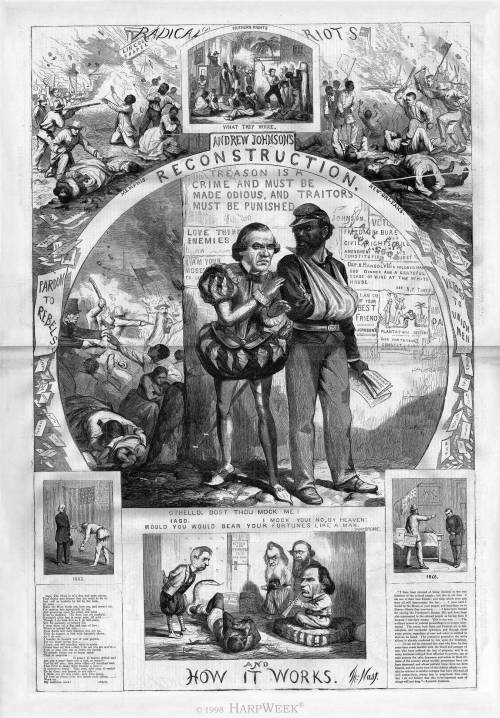
            “A Dangerous Stir” is a marvelous tale of Reconstruction, of Andrew Johnson, a president of amazingly disastrous proportions, including bigot, blowhard, drunkard, narcissist. It is the tale of politicians enlarging upon every suspicion, newspapers enlarging still more, to stir each part of the nation to a swizzling frenzy.  Plots of roving bands of freed blacks, intent upon murder of any whites in sight usually turned out to be drunk whites killing other drunk whites. The Ku Klux Klan stirred up more hatred and distrust, and strung up many innocent blacks. 
Cartoon, “Andrew Johnson’s Reconstruction:  How it Works, Harper’s, 1866
            The radical Republicans finally took President Johnson, an old Jacksonian Democrat, to court in impeachment, but it failed.  A very popular Republican, Ulysses S. Grant, was elected President, and Johnson returned to Washington as a Congressman. 
            Author Summers ends his story with a Coda. “By 1875 it was plain to any thinking person, that is anyone who was not a newspaper editor, that the Union would not be undone, that however much they prided themselves on their southernness, that white southerners would never go out of the Union, would never seek a new war.” One irony of Reconstruction was that fears that were never more than fond fancies were roused so well that when they had been laid to rest and other terrors rose the will to believe was gone.
            By learning about this important period in our nation’s history, it was fascinating to see how much history repeats itself. If you are not paying attention, you believe it is happening now for the first time.
-end-


HISTORY BOOK CLUB TOPICS FOR 2016-2017


Wednesday, November 30, 2016: Colonization in America. Jamestown, Plymouth, Gloucester, St. Augustine, Junipero Serra, Roger Williams, Quebec, Nieuw Amsterdam, more.

December:  No Meeting


Wednesday, January 18 (vice 25), 2017: History of Cape Ann.   Read about the history of Gloucester, or Rockport, or about how Gloucester became famous as a fishing port, or how Rockport gained fame with granite quarrying. Read about Cape Ann as an art colony. Read about the Revolutionary War and privateers off Cape Ann, or the Royal Navy attacking in the War of 1812. Read about how the Sicilian, Portuguese, and Scandinavian immigrants joined the original English settlers here.


Wednesday, February 22, 2017: Pick your favorite Chinese dynasty. Whether it’s Xia dynasty, Shang, Chou (Zhou), Qin, Han, Sui, Tang, or any of the others, you’ll learn Chinese history. [Suggested by Walt Frederick].


Wednesday, March 29, 2017: What made America powerful? Was it our geography, size, natural resources, protection of two oceans, our choice of immigrants, our leaders?  [Suggested by Janos Posfai]

Wednesday, April 26, 2017: History of Class in America   We’ve often bragged that Americans started out resisting the class structure, but our Founding Fathers included men like Thomas Jefferson, owners of much land and slaves. At the same time, indentured servants arrived in young America, to fill the bottom rungs of society. [Suggested by Sam Coulbourn]

Wednesday, May 31, 2017: Famines in the World [Suggested by Linda Burkell and Walt Frederick]


Wednesday, June 28, 2017 History of English/British Colonialism. It started in the latter part of the 15th Century with plantations in Ireland. Read how the United Kingdom grew to become the greatest Empire in the history of the world.  If you wish, home in on British slave trade, and how the U.K. colonized the New World, bringing slaves to grow sugar and cotton. Then Napoleonic Wars and Britain’s seizure of French Colonies. America and Canada.  Colonization of Asia in Hong Kong, Malaya, Australia, New Zealand, India, Burma. Africa, and more for you to discover. [Suggested by Richard Heuser]


Wednesday, July 26, 2017:  Treasure Hunts in History. This is your opportunity to find a treasure and discover the hunt for it, whether it is the quest for gold in California, diamonds in Africa, the hunt for the pharaohs buried in the pyramids, the hunt to discover a cure for polio or yellow fever, the terracotta army buried with Qin Shi Huang, the First Emperor of China, the search for the source of the Nile, the discovery of Neanderthal man… This topic is for you to imagine!  [Suggested by Walt Frederick].


Tuesday, September 27, 2016

Scare-Mongering and Witch Hunts in America

History Book Club
Wednesday,
September 28, 2016
Scare-Mongering and
Witch Hunts in America


Charles River Editors, House Un-American Activities Committee: The History and Legacy of Congress’ Most Notorious Investigative Committee, Cambridge, MA: Charles River Editors, 2016.

Charles River Editors,  McCarthyism: The Controversial History of Senator Joseph McCarthy, the House Un-American Activities Committee, and the Red Scare during the Cold War, Cambridge, MA: Charles River Editors, 2016

            When we see how skillfully Donald Trump activates his audience, so that they follow his lead in denouncing all Muslims, we see a demagogue at work. 

            In the hands of an uncritical throng of believers, the demagogue can heat them up until they will follow his lead.  We saw how demagogues like Benjamin Tillman in the south used this technique to fire up white farmers, telling them that freed slaves were on the rampage, ready to rape their women and kill them.

            Adolf Hitler was a marvelous demagogue, turning Germans against Jews, and eventually causing the death of some six million Jews.


Sen. Joseph McCarthy (R-WI)

            Senator Joe McCarthy found his target, rooting out communists that he claimed were hollowing out our federal government and shaping thought in our colleges and in our entertainment.  He saw communists everywhere.  The State Department was riddled with them.  Hollywood was full of actors ready to use communist skills to turn the whole country into a communist state.

Martin Dies, Jr.

            The House Un-American Activities Committee was formed in 1938, and Congressman Martin Dies (D. TX) served as its chairman until 1944.  Dies, a conservative southerner, had originally supported Franklin D. Roosevelt, but by 1936 he was taking another path.  The HUAC was originally intended to search out un-American activities from the right and the left, as Nazism was rapidly gathering steam.  HUAC looked at the Ku Klux Klan, and other pro-Hitler efforts, but soon concentrated upon the left wing. 

            The Committee brought in Hallie Flanagan for questioning in 1938.  She was head of the Federal Theatre Project, a New Deal initiative that was sponsoring amateur theatre all over the country, in social organizations, trade unions, religious organizations, industries, fraternal organizations and political groups.  Someone had suggested there was a communist flavor in all of this.

            In questioning before the committee, one member asked Ms. Flanagan about one Christopher Marlowe, whom she had quoted in her literature.  “Tell us who this Marlowe is, so we can get this in perspective. Was he a communist?” “put in the records that he was the greatest dramatist in the period immediately preceding Shakespeare,” she replied. Further questioning implicated “Mr. Euripides” as a playwright who “was guilty of teaching class consciousness.”

            Dies apparently was hoping to smear and conquer the New Deal with all this, and he did manage to shut down the theatre program.

            Soon, communists, or people called that, were popping up everywhere.  Shirley Temple, then a Hollywood star at age 10 in 1938, was included in a list of Hollywood actors suspected of red ties, because she had written a letter to the Paris newspaper Ce Soir, which had a reputation of leftist tendencies.  

            Dies brought his committee to Los Angeles for this investigation, claiming that he had been given a list of about 42 prominent members of the film colony who were either full-fledged members of the Communist Party or active sympathizers and fellow travelers. Dies investigated Jimmy Cagney, Humphrey Bogart, Kathryn Hepburn and Fredric March, among others.       
    
            When Congress took up communism in 1938 Americans were conflicted, because we saw a right-wing fanatic in Germany threatening war in Europe; but we also saw danger from Stalin in Soviet Russia.  Some, including Dies, and Father Coughlin, a vocal Catholic priest then gaining a large audience in the U.S. thought that FDR and his New Deal were too cozy with the left.

            FDR and the New Deal prevailed, despite Dies’ and Coughlin’s best efforts. We went on to fight World War II with Russia as an ally.  We officially suspended our misgivings about communism for the duration of the war.  Membership in the Communist Party of the United States peaked during wartime, to about 50,000.

            As soon as World War II ended, Stalin immediately began to swallow up bits and pieces of Europe. France saw a huge increase in sympathy for communism, as did Italy. Communism, and the threat of Reds in America, even embedded in our government, arose again. 

            There was a time when it looked like communism would cover the earth.

            As Americans came home from World War II, and people at home began to live in peacetime, the House Un-American Activities Committee became increasingly active in hunting down communists.  Some real communists got caught up in this. 

            In 1948 Whitaker Chambers, a known communist, appeared before the HUAC. He implicated several in government.  In particular he named a bright young attorney named Alger Hiss. His, born in Baltimore, graduated from Johns Hopkins University and then Harvard. He clerked for Supreme Court Justice Oliver Wendell Holmes, Jr. and then went to work in a prominent Boston law firm.  He soon found a job in the Roosevelt administration, as counsel defending the Agricultural Adjustment Administration against conservative congressmen seeking to disband it.  Then he went to work in the State Department, first as assistant to Assistant Secretary of State Francis B. Sayre, and then in the Office of Far Eastern Affairs.

            In 1944 Hiss became Director of the Office of Special Political Affairs, an office  working to plan the postwar world, including creating the United Nations. This took him to the Yalta Conference where FDR met with Churchill and Stalin to plan for the world after Hitler was defeated.  After the war, Hiss became President of the Carnegie Endowment for International Peace.


Alger Hiss, 1950
            Even though he had been named by Chambers, Hiss might have been lost in the shuffle, but an aspiring young communist fighter named Richard Nixon took up the cause, claiming that he alone was responsible for nailing Hiss, because the Justice Department would not prosecute, and J. Edgar Hoover didn’t cooperate.  Nixon leaked Hiss’ name in the papers, and eventually brought him in.  “I had Hiss convicted before he ever got to the grand jury”, Nixon bragged.

            On January 20, 1950 Hiss was convicted of espionage and sentenced to five years in prison.

            After the Hiss conviction, HUAC was flushed with success, and again went on a hunt for communists in Hollywood.  This began an era of accusations, blacklists, people reporting on each other.  Even when there was no proof, people’s names were brought up, their reputations ruined, as the threat of “Red scare” ran rampant.  Even President Truman, who criticized HUAC as being itself “un-American”, found he was powerless to shut it down. It was a bad time for American justice.

            In February 1950 a little-known senator from Wisconsin, Joe McCarthy, spoke to a Republican women’s club in Wheeling, WV, claiming that he had a list of known communists in the State Department. He began to build a reputation as the most prominent communist hunter in government. When pressed for details, he refused to give any. When people questioned his evidence he’d accuse them of being communists themselves. 
Ethel and Julius Rosenberg

            Julius and Ethel Rosenberg were brought to trial for espionage, in particular for stealing the secret of the American atomic bomb and passing it to the USSR, this gave McCarthy more assurance. They were convicted in March, 1951 and executed in June 1953.

            The climate in America was ripe for hunting communists in the early 1950s.  The USSR had exploded its first atomic bomb in August 1949. America, just five years after World War II ended, was fighting the Communist North Koreans. Red China had consolidated its rule over China, pushing the Kuomintang and Chiang Kai-Shek off the mainland and onto the island of Taiwan.

            Today, young people might have a hard time taking Communism seriously, because the Soviet Union has collapsed, East Germany is no more, and democratic governments have taken over in Bulgaria, Rumania; Czechoslovakia and Yugoslavia have split apart. Unless young people read history, they cannot know how, after we had thrown off the threat of the whole world being conquered by Germany and Japan, communism began to cover the earth, in China, maybe Greece, maybe Iran, maybe India, maybe Egypt, Syria, Africa, certainly in Cuba and maybe elsewhere in Latin America.

            McCarthy fought to gain traction in this environment by playing on the fears of Americans. Just like Martin Dies had fought against Roosevelt’s New Deal, now McCarthy tried to show that Truman’s Democratic administration was soft on Reds.

            Today we are seeing the same sort of fear-mongering, as a presidential candidate seeks to sow seeds of distrust and play to the fears of Americans by urging the exclusion of all Muslims, and expulsion of some 11 million illegal immigrants.

            Gradually, McCarthy’s campaign to hunt down communists began to create the climate of fear and distrust he sought.  People were reporting on their neighbors.   It seemed as if communists were everywhere. Truman never fell under his spell, nor did many other leaders in Congress, but Congress willingly voted for funds to continue the investigations. McCarthy particularly went after General George C. Marshall, five-star hero in World War II and, later, as Secretary of State, creator of the Marshall Plan to save Europe after the war.  McCarthy claimed that Marshall was leading America toward disaster against the USSR.

            In 1953, Dwight Eisenhower took office. Although a Republican like McCarthy, “Ike” did not fall under McCarthy’s spell either.  McCarthy, who had been a junior officer in World War II (he ran for election  as “Tail Gunner Joe”) was not afraid of Ike, who had earned five stars as the general in World War II who commanded all allied forces in Europe. In 1951 he became the first commander of NATO, and later the president of Columbia University. He was in that position when he was elected President in 1952.

            McCarthy rolled on with his campaign to root out communists. He published books, and issued congressional pamphlets telling how to spot communists in our midst. He was quick with accusations, and careless with justification.  He was gradually building up opposition. At this time, he had a very smart, aggressive assistant named Roy Cohn, and Roy used his position on McCarthy’s Senate investigative staff to engineer the commissioning of a former staff member, recently drafted David Shine.  The Army found him unqualified for a commission and refused. Cohn swore to get rid of Army Secretary Robert Stevens.

            McCarthy sought to go after supposed communists in the Army.  It turns out that this was going too far for the American people. In June, 1954, before a national television audience, McCarthy tried his usual bullying tactics against the Army. Army Chief Counsel Joseph N. Welch turned the tables on McCarthy, and this marked the beginning of the end.

            This bullying blowhard was shown as the cowardly demagogue he had become, and soon he was brought before the whole Senate for censure.

            McCarthy kept his seat, but disappeared from the national media, began drinking heavily, and died in 1957. He was 48 years old.

            HUAC continued to operate, but finally was disbanded in 1975.


Sen. McCarthy questions Joseph N. Welch, Chief Counsel for the
U.S. Army, during investigation into communist activities, June 9, 1954

-end-

HISTORY BOOK CLUB TOPICS FOR 2016-2017


Wednesday, September 28, 2016: Scaremongering and Witch Hunts in America. Salem Witch Trials, House Un-American Activities Committee; McCarthy Investigations; more.


Wednesday, October 26, 2016:  Political Parties in America. Whigs, Know-Nothings, Federalists, Copperheads; Communists, Socialists, Republicans, Democrats, more.


Wednesday, November 30, 2016: Colonization in America. Jamestown, Plymouth, Gloucester, St. Augustine, Junipero Serra, Roger Williams, Quebec, Nieuw Amsterdam, more.

December:  No Meeting


Wednesday, January 18 (vice 25), 2017: History of Cape Ann

Wednesday, February 22, 2017:

Wednesday, March 29, 2017:

Wednesday, April 26, 2017:

Wednesday, May 31, 2017: