Saturday, December 10, 2011

New England Graveyards


Old Fifth Parish Cemetery in Rockport, MA

          Our home is located right next to a beautiful old graveyard on a slope that goes down to a beach on the Atlantic Ocean.  Richard Tarr, the founder of Rockport, grew crops here.  Then, he gave this piece of land to the young village as a burial ground. He is buried here. 

Gravestone of Richard Tarr (b. 1646-d. 1732)

            We have a lot of visitors to this old burying ground, because nearly every stone is a lesson in the history of our country. 
            There are men who fought in the Revolutionary War, the War with England in 1812, women who lost their husbands at sea, in war and peace, and many children.
            Union war dead are buried one lane away, less than 100 feet more distant from the sea.
            Hannah Jumper is buried in our Old Fifth Parish Burial Ground.  She’s famous here because this quiet spinster was a woman of action.  In the middle of the Nineteenth century Rockport had a large number of sailors and fishermen, and a large number of little pubs and bars where the men would hang out.  They’d often get drunk and then go home to their wives. 
This went on for years, but in 1856 the Temperance Movement was gaining steam all over the United States (31 states).  The women in town had had about enough of this, and the preachers downtown helped stir up their emotions.  Local women gathered and decided that on July 8th they would take matters into their own hands.  They trusted no males with their plans, except for three preachers.
On that fine summer morning Hannah, age 75, put down her sewing, and marched out of her house down by the harbor, and led a group of angry, determined women and preachers down the street. The women had hatchets under their shawls, and they stormed into one bar after another, smashing bottles, and emptying kegs in the street.  Pub owners and customers alike couldn’t believe what was happening.
The women smashed kegs for five hours. Then they went home to cook supper for their families.
That was the end of drinking in Rockport.  Bars and pubs were outlawed, and only in 2005 did citizens finally vote to allow restaurants to serve alcoholic beverages.  149 years.
  
Hannah’s tombstone


Old Burial Ground in winter

            While we are on the subject of burial grounds, I’d like to tell you about a fascinating new book:
Final Thoughts: Eternal Beauty in Stone by John Thomas Grant, Foreword by Doug Keister. 2011. Atglen, PA: Schiffer Publishing Co. 170 pp. 28.5 x 23 cm. US$34.99.

            The cover illustration was one of the many magnificent photos that John Thomas Grant took for this book, which is a beautiful, thoughtful, pictorial survey of old graveyards of New England, New York and Pennsylvania.  Most are from graveyards right here on Cape Ann.
            The inscriptions are not always dry, lofty phrases from the Bible, and sometimes they give you an insight into what the “loved ones” really thought about the departed one.


Graves of John, Abigail, Martha and Mary Story
Final Thoughts, p. 22

            On a set of gravestones in a Gloucester cemetery, author Grant found these inscriptions:

On Abigail Story’s stone--
“Grieve not for me, my husband dear;
I am not dead, but sleeping here;
with patience wait, prepare to die,
and in a short time you’ll come to I.” (1851)

On John Story’s stone:
“I am not grieved, my dearest wife
sleep on, I’ve found another wife.
Therefore I cannot come to thee,
for I must go and live with she.” (1851)

            That wife, Abigail, died in 1851.  The busy John Story then married Martha, who died in 1862; then he married Mary A., who died in 1888.  I wonder if John just wanted to make his verse rhyme or was just being polite to Abigail when he wrote “with she”?


The Personal Navigator offers these books and papers:

Vermont Journal, Brattleboro, Saturday, April 9, 1881 Brattleboro, VT:  The Journal Company. The sacredness of the Sabbath is not always observed by politicians.  Last Saturday Senators Conkling and Platt, Governor Cornell, Vice President Arthur and Postmaster-General James  did not get through comparing notes until Sunday. Four years ago Conkling engaged in a power struggle with President Hayes.  "The Hero of Gettysburg" was not General Hancock, recently defeated in the national election by Garfield, but General Meade.  There are at least a dozen Senators who may be called millionaires, led by Sen. Fair of Nevada, probably worth as much as all the others put together.  Next is Davis of Illinois who has gathered millions, as well as 375 pounds avoirdupois. Sawyer of Wisconsin, who was a poor Vermont boy, is next.   The Story Teller:  "Poor Miss Brackenthorpe" --what was revealed after she died. Illustrated ads for Perry Davis' Pain Killer, The "Only" Lung Pad, Madame Griswold's Skirt-supporting Corsets. 8 pp. 40 x 58 cm.   Newspapers, numerous tiny tears in creases, paper unopened, fair. (8198) $24.00. Newspapers/History

Universalist, The; and Ladies' Repository; Boston, Saturday, February 8, 1834 Smith, Daniel D., Editor 1834 Boston, MA Daniel D. Smith. Address delivered at the funeral of Matthew Jasper Smith, only child of Rev. M.H. Smith of Hartford, CT.  An Address delivered before the First Society of Universalists in Danvers, MA at the Dedication of their church, June 28th, 1833, by Rev. L. Willis. Excuse for Neglecting Public Worship-- the fourth excuse is the expense of public worship; fifth excuse is that many can not keep awake in church. Extract from a New-Year's Sermon by Rev. T.B. Thayer. The Trial of Abner Kneeland for blasphemy ended yesterday with a verdict of guilty. Caution to Mothers, No. 1: "Do not talk about children in their presence."  "..if mothers exercise care, and proceed cautiously, they will save their children from years of woe, and adorn their handsome children with that greatest of all ornaments-- 'a meek and quiet' which in the sight of God is of great price." Hints to Young Females. "The sentiment for woman has undergone a change.  The romantic passion, which once almost deified her, is on the decline; and it is by intrinsic qualities that she must now inspire respect.  There is less enthusiasm entertained for her, but the regard is more rational, and perhaps equally sincere." 16 pp. 18 x 27 cm. Paper periodical, edges cut unevenly, good. (7382) $16.00. Religious

image
Thompson, Rev. Otis: Sermon, A, Preached November 29, 1821; The Day Which Completed One Hundred Years Since the Organization of the Congregational Church in Rehoboth, Mass. By Otis Thompson, A.M., Pastor of Said Church 1821 Taunton, MA: A. Danforth, Printer. 23 pp. 14 x 23.7 cm.    Reverend Thompson (b. 9-14-1776) served as pastor of the Rehoboth Congregational Church for over 25 years. In this sermon he takes for his text Acts IX, 31, and describes how Saul of Tarsus was "exceedingly mad against the saints of Christ Jesus: and acting uinder the highest authority in the Jewish church, shut them up in prison, punished them oft.... when they were put to death, gave his voice against them," Then, on the road to Damascus, he was "arrested by a light and voice from heaven... was changed from a blasphemer to a preacher of the faith which before he destroyed. Rev. Thompson ends his sermon with words from Christ: "He who is not with me, is against me, and he that gathereth not with me, scattereth abroad."     Paper booklet, bound with thread, moderate wear, good. (7704) $36.00. Religious   

Seven Sermons, On Different Important Subjects; by Robert Russel at Wardhurst, in Sussex 1791 Philadelphia, PA: Peter Stewart.  Small book offers sermons on:  I. The Unpardonable Sin against the Holy Ghost: or the Sin Unto Death; II. The Saint's Duty and Exercise: Being an Exhortation to, and a Direction for Prayer; III. The Accepted Time, and Day of Salvation; IV. The End of Time, and Beginning of Eternity; V. Joshua's Resolution to serve the Lord; VI. The Way to Heaven made Plain; VII. The future State of Man: Or, a Treatise on the Resurrection. 144 pp. 8.5 x 14.2 cm. Paper on board with leather spine, very worn, but intact. Inside front hinge cracked. Front pastedown contains name that is heavily scratched out. No free endpapers. Fair. (6991) $115.00. Religious

Sermon Preached August 9, 1826 at the Ordination of the Rev. Stephen Thurston over the Congregational Church and Society, Prospect, Maine, by Rev. David Thurston of the Winthrop, Maine Congregational Church. Hallowell, ME: David Thurston, Pastor, Winthrop, ME. Congregational Church.  If thou put the brethren in remembrance of these things, thou shalt be a good minister of Jesus Christ, nourished up in the words of faith and of good doctrine, whereunto thou hast attained. I Timothy, IV, 6
Sermon by famous anti-slavery preacher, David Thurston, with theme from I Timothy, IV, 6. Cites requisites for a good minister of Jesus Christ. This copy inscribed by David Thurston to his uncle, Samuel Bacon. 16 pp. 14 x 21 cm. Paper booklet, covered with coarse heavy paper. First four pages have 10 cm closed tear across middle, other pages have 2 cm tear in edge. Soiled, worn, poor. (5727) $46.00. Religious/History
[Rev. David Thurston was one of the Congregational church's most prominent ministers. Reform-minded and idealistic. He started the first Sunday school in New England. He was a pioneer in all matters of reform and a leader outside of his community on the great questions of the day. He formed the Winthrop chapter of the American Anti-Slavery Society in 1834, and for years before the Civil War he was a leading voice in the cause of abolition of slavery. In fact, he was so strongly anti-slavery that his parishioners forced him to resign, ending a 44-year stint as pastor in Winthrop.
Church members today say they carry on Thurston's message of social activism by running programs on family violence and an after-school program for middle school students. ]

Self-knowledge: A Treatise, Shewing the Nature and Benefit of that Important Science, and the Way to Attain it. Intermixed with various Reflections and Observations on Human Nature. by Mason, John, A.M. 1778 London, England: James Buckland at the Buck in Paternoster Row. Famed Non-conformist's Treatise discusses aspects of self-knowledge; overcoming temptation; humility; abstinence; knowing our natural tempers; fervent and frequent prayer. 228 pp. 11 x 17 cm. Calf on board, top and bottom of spine, edges of cover rubbed and worn. Poem by Cowper penned in ffep in 18th c. hand. Pen marks in book mark key passages. Owner inscr. Good. (1311) $70.00. Religious/Educational/Philosophy.

Reverend Pike's Discourse Delivered in the Congregational Church, Rowley, MA at the Annual Thanksgiving, November 26, 1846 Pike, Rev. John 1846 Boston, MA: S.N. Dickinson & Co. Text from Ezekiel 21:27. Are there grounds for contending nations of the earth to regard themselves as the messengers of Deity to overturn each other? Does part of the job belong to us?  Preacher is talking about the current war with Mexico, and also British aggression in China, and French encroachments upon islands of the sea. Our war with Mexico urged on by land speculators, slave-holders and selfish adventurers..."What evidence that the voice of God was calling us beyond the river Nueces?  Was admitting Texas to the Union constitutional?  Mexico was looking up to us... But we chose the sword... And now they burn with hatred towards us.  Pray for your nation, and the kindred nations....a voice more acceptable to heaven than the roar of your cannon." 15 pp. 14 x 23 cm. Paper leaflet fastened with thread stitching. Chip 2 x 3 cm missing from one page, some soiling, fair. (7422) $17.00. Religious


Monday, December 5, 2011

Looking for Soviet Subs


  it was not a game...


Soviet Missile Ship Moskva at sea in the Mediterranean, ca. 1976
                  
The Navy ordered me to Naples, Italy to coordinate the search and tracking of Russian submarines operating in the Mediterranean Sea.  It was 1975 and the Cold War was in full swing.
The Mediterranean Sea was a seven-ring circus for the United States Navy, because the whole war of threats and counter-threats between the Union of Soviet Socialist Republics and the United States played out here, every day. 

I was going to a job conducting around the clock airborne surveillance of the Mediterranean Sea.  At the time, the Israelis and all the Arab countries around them were in a state of tension.  Pretty much like today, except in those days, the Soviet Union backed the Arab States, most African states, Albania, Yugoslavia and the United States, as a part of NATO, had bases in Italy, Greece, Spain, Turkey and Iran. Like today, we backed Israel in their confrontation with their Arab neighbors, and the Soviets. There were many more little alignments, but always with the Russians taking one side and the Americans the other.     
We were a part of the Sixth Fleet, operating in the Mediterranean.  That force included two aircraft carriers, numerous destroyers, cruisers, patrol craft, ammunition and fueling ships, land-based air patrol craft, and submarines.
The Soviets also deployed a fleet of missile cruisers, destroyers and submarines in the Mediterranean
Today, with the benefit of hind-sight, it is hard to imagine the tension between all these ships and aircraft operating here, but when you consider that both sides went to sea loaded with all kinds of nuclear and conventional weapons, and even a small misunderstanding between forces of the USSR or the USA could have disastrous consequences. And--  all those client states were continually cooking up minor and major incidents that could drag the whole world into war.
            My job was to use my experience in submarines and destroyers to work with naval aviators in searching for Russian submarines.  We employed land-based maritime aircraft and airborne early warning planes, and we coordinated with the antisubmarine elements aboard the carriers, and their escorting destroyers.  We shared our headquarters with the staff that coordinated American and NATO submarine operations.
            Often I would fly out to Rota, Spain, or to Sigonella, Sicily, where our aircraft were based, and join them on one of their 12-hour missions.  Sometimes I’d be taken on a COD (carrier onboard delivery) plane to land on one of our carriers, to take part in a coordinated antisubmarine warfare operation, which involved Sixth fleet carrier aircraft, our land-based patrol aircraft, as well as destroyers and submarines, all tracking a Soviet submarine, with or without the interference of the Soviet surface warships in the area.
Our submarine crews became quite skilled at picking up a Soviet submarine out in the Atlantic and trailing him into the Mediterranean.  Sometimes we’d organize a squadron of destroyers with sophisticated towed sonars aboard, and they would coordinate with our submarines and aircraft to track the Russian. 
At times Soviet surface warships would show up and get right in the middle of our tracking operation.
One day we were conducting a large operation that used carrier-based air, destroyers and land-based air to track a Soviet nuclear missile submarine. This type of submarine carried anti-ship missiles, and the Soviets positioned them to attack our aircraft carriers.
 We had tracked him to the Central Mediterranean, just west of Crete and south of western Greece.   One of our towed array frigates, USS Voge (FF-1047) was tracking him closely when sailors on the frigate noticed that the submarine had popped up and was behaving like a porpoise, speeding, still submerged, but with her periscope sticking up, and then part of her sail.  She was heading right at the frigate!
USS Voge displaced about 2600 tons, but this submerged monster displaced as much as 5700 tons, and she was traveling at a speed of about 18 knots.
Here’s a photo someone aboard Voge shot, just before the submarine collided:
            
           
Photo taken from deck of USS Voge as Soviet submarine
collides at sea off Greece, Aug. 28, 1976

Soviet Photo of nuclear submarine K-22
after collision with USS Voge 8-28-76

            You can see considerable damage to the sail of the Russian submarine, and there was also damage to the hull of Voge, so she had to go into drydock in Toulon, France shortly afterward.  One sailor aboard Voge was injured.

           
            Some fine people will read the foregoing here in the year 2011, and say, “how stupid you all were to be playing with the lives of all of us like that!”   Since the Cold War began right after World War II ended, up until the Soviet Union collapsed in 1991, we lived in a world of continual tension.
            The Soviets tried very hard to grab up as much territory as they could as World War II ended, and countries that they couldn’t swallow up then they worked hard with elements in those countries to create Communist regimes. 
We had just defeated Germany, Japan and Italy to keep ourselves from being swallowed up by fascist forces, and now the Communists wanted to take over the world.
            They had a lot of successes, and if we had ever “relaxed” and let the Russians, the Red Chinese, and the communist states in Czechoslovakia, Viet Nam, Cambodia, Laos, Bulgaria, Yugoslavia, Albania, Rumania, Cuba, Poland and elsewhere have their way, they might have succeeded.
            We weren’t “playing”, and neither were the Russians.

Here are some books and papers that The Personal Navigator would like to offer you:


Abdul Buhl: The Chronicles of Abdul Buhl by Leslie F. Deacon, Illustrations by Polly Hill ca. 1948.  These are the timeless adventures of Abdul Buhl the terrible, and Morbhid Dhung, his man, told in verse.  Charmingly illustrated by Polly Hill, Adul and Morbhid cross a desert, go out to sea, meet some Amazons, including Sweet Ahlmad Buhl, from Abdul's clan. They encounter Whirling Dervishes, Attila's Huns, sail back over the sea to Araby the Fair.  [Author believed to be the same L.F. Deacon b. 1913 who served in the RAF in World War II and taught at Tanglin in Singapore after the war, then moved to Northern Rhodesia (now Zambia) and then South Africa.] 23 pp.           13.5 x 23.8 cm. Green suede leather cover, text block loose from binding, poor. (8200)   $39.00. Poetry


Russo-Japanese War Commemorative Post Cards, 1905

Portsmouth Navy Yard Peace Conference 1905-- Set of five post cards commemorating Russo-Japanese War Peace Conference 1905          Portsmouth, NH: First National Bank. Set of five postal cards commemorate the Russo-Japanese War Peace Conference sponsored by President Theodore Roosevelt. Two cards show participants: Sato, Takahira, Komura, Otchai and Adachi for Japan, and Korostovetz, Navohoff, Witte, DeRosen and Plancon for Russia. Another card shows inset pictures of Czar Nicholas, the Mikado and President Roosevelt.         5 cards 13.7 x 8.7 cm.   Four photographic post cards and one printed post card, all very good. (8202) $45.00. History

Art Metal Steel Office Furniture and Filing Supplies, 1915 No. 757 1915 Jamestown, NY: Art Metal Construction Co.            All the modern business needs--the best steel office equipment in the world, according to E. St. Elmo Lewis, General Manager.  Photo of Art Metal Engineering Department. Fire resistance of Art Metal. Cast Bronze Hardware. Features of Art Metal Files--why they excel. File Drawers, Upright Units, Vertical file units, Suggestions for voluminous correspondence, vertical file guides, file folders; card record units, tabulating card units, sections for folded documents, depositi slips, checks and vouchers, private lock drawer sections, unit record-card desks, bond boxes, plan files, waste baskets, shelving, desks, tables, typewriter stands, safes, vault equipment.            80 pp.   20 x 27.5 cm.    Paper booklet, cellophane tape repairs to spine, good.            (8199) $28.00. Advertising

Boston Weekly Journal, Boston, Mass., Thursday Morning, February 25, 1869    Boston, MA: Charles O. Rogers, 120 Washington St. Dispatch from St. Louis reports that all of the Kiowas except four or five lodges have come in to make peace, and will at once be assigned reservations. Kiowas have been the most troublesome and hostile of the frontier tribes. Part of the Arapaho and Cheyenne tribes have also presented themselves at the Government headquarters for assignment ot reservations. Gen. Cushing met with success in negotiations with the Government of Colombia for the right to construct an inter-oceanic canal across the Isthmus of Darien. Discussion about the way that the President-elect, General Grant, is going about forming his Cabinet.  Meager information from Cuba indicates that troubles there are daily becoming more serious, and both the Spanish government and Gen. Dulce have misapprehended the extent and true nature of the outbreak.  Bands of insurgents are making their appearance in every part of the island.        4 pp.     52 x 68 cm. Newspaper, worn, dampstained, good. (8197) $25.00 Newspapers/History

Vermont Journal, Brattleboro, Saturday, April 9, 1881 Brattleboro, VT:  The Journal Company. The sacredness of the Sabbath is not always observed by politicians.  Last Saturday Senators Conkling and Platt, Governor Cornell, Vice President Arthur and Postmaster-General James  did not get through comparing notes until Sunday. Four years ago Conkling engaged in a power struggle with President Hayes.  "The Hero of Gettysburg" was not General Hancock, recently defeated in the national election by Garfield, but General Meade.  There are at least a dozen Senators who may be called millionaires, led by Sen. Fair of Nevada, probably worth as much as all the others put together.  Next is Davis of Illinois who has gathered millions, as well as 375 pounds avoirdupois. Sawyer of Wisconsin, who was a poor Vermont boy, is next.   The Story Teller:  "Poor Miss Brackenthorpe" --what was revealed after she died. Illustrated ads for Perry Davis' Pain Killer, The "Only" Lung Pad, Madame Griswold's Skirt-supporting Corsets. 8 pp.           40 x 58 cm.       Newspapers, numerous tiny tears in creases, paper unopened, fair. (8198) $24.00. Newspapers/History

London: The Canadian's Guide Book to London 1937 1937 London, England: High Commissioner, Canada House. Guide book for the Coronation, May 12 and all other events in 1937. Includes colored folding map of Central London, showing the Coronation Parade route. 65 pp. 12.2 x 15.1 cm. Paper booklet, owner name written on inside front cover. Inside front hinge slightly loose. Good. (8201) $24.00. Travel

Shipmate, The Eyes and Ears of the Navy; Publication of the United States Naval Academy Alumni Association, September 1945         1945 England, Harry W., Managing Editor. Annapolis, MD: U.S. Naval Academy Alumni Association. Victory and Industrial Issue: End of World War II came as a surprise to editorial staff, so they rushed to include "The Sinking of the Rising Sun" by Lt. S.L. Freeland. "a concise and vivid report of how U.S. Navy made Japs wish they had never thought of Pearl Harbor." Story of new USNA Superintendent, first Naval Aviator to take post, Vice Admiral Aubrey W. Fitch, '06, by Comdr. Louis J. Gulliver, '07. "Ships from the Texas Plains" story of ships built by newcomers to shipbuilding in Houston. These ships passed the "final examination" when they survived the horrible typhoon off Luzon in December 1944, that caused sinking of three other destroyers. "How the Seabees Transformed Tinian" as base for Superforts bombing Japan. "P.H. to Okinawa"-- "’The Big E’, carrier Enterprise, fought the whole bloody war, and came out asking for more”. "What's the Dope" news of alumni, first entry is from Col. Harry Hawthorne, Class of 1882.  Names of naval officers mentioned in this issue is an honor roll of naval heroes of World War II and afterward. 104 pp. 21.7 x 29.3 cm. Magazine, moderate wear, good. (6229) $35.00. World War II/Naval                                  


Thursday, December 1, 2011

Starting at the Bottom In the Newspaper Business…


... and Climbing Up One Rung


Downtown Port Arthur, Texas, ca. 1950, with tanker going through Intracoastal Canal

            How do kids today pick the life they hope they’ll have? 

            When I was a kid, I    I loved broadcasting and the newspaper business, and thought my future was there.
            I started in at the very bottom, as a 10-year-old newspaper boy, delivering The Port Arthur News to the section of town where I lived. Collecting the subscription fees was something I had to do each month, and this was painful, because people were not eager to part with $1.10 for their daily and Sunday paper. Sometimes they’d give a tip, which would have been about ten cents.  This was 1944, during World War II.
            There were a couple of large mansions on my route, and I’d visit them only once a year, and they’d shell out the grand amount of about $12.00 plus a five dollar tip. 
            The day the distributor brought newspapers reporting that the war had ended was a day I’ll always remember.  Without television and cell phones and all the instant communication today, when I gave people their paper, it may have been the first word they got that our war with Japan was finally over.  That was August 15, 1945 when the Japanese agreed to surrender, and the actual surrender was September 2, 1945.  There hasn’t been a day like that in America since!  Everyone was ecstatic.

When I was about 14 I found out about these marvelous things called Mimeograph stencils. They were legal size documents that consisted of a fiber sheet that you could type on and if you remembered to type without a typewriter ribbon, it would make indentations in this fiber sheet. 
            Then you’d fasten this onto the drum of a Mimeograph machine, make sure it had plenty of ink, and then start to crank it around and print on sheets of paper.


Mimeograph Machine

            You could even make drawings on this Mimeo stencil.  This was a long way from Xerox!
            We produced quite a few newspapers for distribution to the other kids at Woodrow Wilson Junior High School in Port Arthur, TX.  Our first one was The Nitwit News.        
Later I found my way to the staff of the Jr. High newspaper, and then to the Thomas Jefferson High School newspaper, The Yellow Jacket, which was actually printed on a press at our school.
            Next, as a high school senior, I got a job at The Port Arthur News as an engraver operator, which meant I operated the Fairchild machine that scanned photographs and burned dots onto plastic on a rotating drum.  These became the “cuts” used in the printing process.  I also operated the machine that received daily transmissions of United Press Telephoto.  This would be an 8” x 10” sheet filled with UP photos of newsworthy events for the day, sent down from UP in Dallas The editor would choose the ones he wanted, and I’d engrave them for cuts.
            I also took photos for the paper, using one of those wonderful old Speed Graphic cameras with film in plastic or metal holders.  I was simply an adjunct to the regular photographer, Jimmy Everett.   Between developing the telephotos and my pictures, I spent over an hour a day in the darkroom, which was a small closet that smelled of the hypo used to stop and fix the photos.  Since the telephotos arrived sharply at noon, I would eat my lunch while I waited for the photos to dry on the photo drier.  At that time my mother had gotten into a rut with making my lunch, and usually made tuna fish sandwiches, so my darkroom smelled of a combination of hypo and tuna fish. 
            That may be why I still avoid tuna fish sandwiches.
            I also had writing duties.  Sometimes I’d get assigned a fire or a storm to cover, or perhaps an interesting local death.  What a thrill it was to see my story, with byline, right on page one!  It only happened a few times, but it was always exciting.
            Morty Goldman was a reporter at the News who typified the reporter of those days.  He was a smart, inquisitive reporter who had a way of getting statements from people that no one else could get.  He was the main attack man for the local chapter of the Newspaper Guild, the union for the editorial people.  We had strong unions for all the stereotypers, teletype operators and pressmen, and they were very serious about their union membership.  Morty tried hard to get me to join the Guild, but I never did.
            The Newspaper Guild. I think one thing that made me leery of the Guild was that some of the members, especially Morty, were really nasty about management, especially about our Editor, John Ayres.  They were always spreading stories about him, and whispering behind his back. Even as a kid in high school, I saw that Guild as the very same slice of life as those kids in school who always resented someone whose parents were in the local country club, or whose parents had graduated from college, or just “put on airs.” 
            It seems as though some people are destined to spend their whole life resenting others, whom they perceive to have more of this or that, or have “breaks” or advantages that they never had. 

            Perhaps that is why I have little sympathy with the Occupy Wall Street people, because so much of their language is predicated upon envy and resentment.  I have no sympathy with people who have managed to buy off members of Congress, and use money to create rules and regulations to insulate themselves from the world. But I am sensitive to the politics of resentment.
            Certainly there was a genuine need for labor unions which were formed to prevent the exploitation of workers, and to enable them to achieve better wages and working conditions, and some of those features of unions are still vital today. 
            But the constant undercurrent of gossip, and resentment and envy that I was exposed to turned me off, because I identified with the Editor and the management staff, trying to put out a good newspaper every day.

            The newsroom of this mid 20th century newspaper was a large room with a central table for the city editor,  the managing editor, the wire editor, and a couple of reporters.  At the near end of the room were the Society section ladies:  Society editor Grace Foote; and two other women.  At the far end of the room was the Sports section.  I usually sat at an empty typewriter in the Sports section. 
            Next to the sports section was a glassed-in room that housed the teletype machines and my telephoto machine.  It was pretty noisy, with those INS, AP and UP machines all clacking away, then at noon my telephoto machine would go “beep-beep” as the black dots would come over the telephone line.  An addition arrived during my time there, when Associated Press would send their stories on a punched tape, so our wire editor could take them right to the linotype people and they would feed the tape to a linotype machine and it would make the little slugs of type without a human at the keyboard.  In our union shop, that was not greatly appreciated. 
            The linotype machines and the stereotype department were all at the back on the same floor as the newsroom.  It was hot in there, with the hot lead being used to make the type, and then the slugs would be mounted in large page-size forms by the stereotypers and then a sheet of paper-like material would be placed over it and pressed to make a page.  Then this would be put into a mold and hot metal would be injected to make a cylinder that would be sent down to the press room below. 
            I loved every bit of this, and often spent so many hours at work that, in spite of attending school daily, I put in over a 40-hour week. 
            
            I really enjoyed my life in the newspaper world. 

[I kept in touch with John Ayres, editor of the PA News, for years, and sent back weekly dispatches when I was at Texas U. from 1952-53, and less frequent dispatches on up to our time in Iran, 1970-72. A graduate of University of Texas, LLB 1923, Ayres died in December 1982.]


Let the Personal Navigator introduce you to some papers and books:

Wrestling on USS Kearsarge, 1908

Postcard: Life in our Navy--Wrestling on the Kearsarge (BB-5) (Color Postcard from Great White Fleet)          1908            Kentfield, CA: M. Ettlinger Co., New York. 1 card 13.9 x 8.9 cm. Color postcard shows men in wrestling match on USS Kearsarge, surrounded by many sailors. Handwritten message on card: “Kentfield (Cal.) May 8, '08. Yes the fleet is here & great time we are having. Biggest parade Frisco ever had.  Population doubled. I was about ten ft. from Bob Evans. (Rear Admiral, Commander of Great White Fleet). Fleet is to stay till about May 17." Color post card, very good. (8220) $15.00. Navy/Nautical    


Lindbergh Kidnapper tells his story

Boston Evening American EXTRA Tuesday, October 16, 1934 Headline: "Hauptmann's Own Story"    1934            Boston, MA: N.E. Newspaper Publishing Co. Headlne story: Bruno Richard Hauptmann denied on the witness stand this afternoon that he had killed litle Charles A. Lindbergh, Jr. on the night of March 1, 1932. Also: "F.H. Tarr, Jr. Shot By Woman Client" in Gloucester, MA. "Revenge Clues are Sought in Stolls' Bride Kidnapping". Dorothy Thompson, wife of Sinclair Lewis, spoke at Northampton last night about Germany and Hitlerism. Expelled from Germany for her articles on Hitler, she told students at Northampton that the greatest menace to his rule in Germany was a "petering out" of the war-like spirit there, due in part to the fact that there were no wars to fight.       20 pp.   42 x 55 cm.       Newspaper, quite brittle, edges chipped, poor.    (8213) $20.00. Newspapers

Nothing like a Kidnapping to sell papers
  
Boston Evening American Wednesday, October 17, 1934 Sport Flash Edition. Headline: "Kidnap Trio to Face Death" 1934 Boston, MA: N.E. Newspaper Publishing Co.  Headlne story: A new outbreak of kidnap threats upon safe return of Mrs. Alice Stoll, 26-year-old Kentucky socialite. Federal agents revealed a $5000 death letter threat which was sent to Edsel Ford. Edward Lickwala has confessed to sending the letter.  Boston police are searching for Thomas H. Robinson, alleged crazed kidnaper of Mrs. Stoll.  In this issue: U.S. Agents tell inside story of Stoll kidnapping.  Harry Pierpont, the "brains" of the Dilliger gang, was executed today in Ohio Penitentiary.  Hauptmann appeals from extradition set for Friday. Story includes enlarged samples of his handwriting, in discussion over whether he wrote ransom note in Lindbergh kidnapping and killing.    24 pp.   42 x 55 cmNewspaper, quite brittle, edges chipped, poor. (8214) $22.00. Newspapers


Navy vs. William & Mary, 1955


Navy vs. William & Mary Football Game Program, September 24, 1955 1955 Annapolis, MD: United States Naval Academy. Program for football game at Thompson Field, Annapolis between Navy and William & Mary. Program cover shows Navy Midshipman smoking an Indian Peace Pipe (in the days before marijuana) and an Indian looking quizzically at a Boatswain's pipe.Many ads by Defense contractors. Photos of Navy and W&M players. Captain of Navy team was John L. Hopkins; W&M Co-Captains were Al Grieco and Bill Marfizo. RADM Walter F. Boone was USNA superintendent. VADM (Ret.) Alvin Duke Chandler was president of William & Mary.  Edward J. Erdelatz was head coach of Navy, John J. Freeman was head coach of W&M. Centerfold featured index of players by their jersey numbers, with large ad for Lucky Strike cigarettes. 76 pp. 21 x 28.3 cm. Football program, color cover, very good. (8215) $29.00. Education


Rev. Otis Thompson’s Sermon, Nov. 29, 1821

Sermon, A, Preached November 29, 1821; The Day Which Completed One Hundred Years Since the Organization of the Congregational Church in Rehoboth, Mass. By Otis Thompson, A.M., Pastor of Said Church 1821 Taunton, MA: A. Danforth, Printer. 23 pp. 14 x 23.7 cm. Reverend Thompson (b. 9-14-1776) served as pastor of the Rehoboth Congregational Church for over 25 years. In this sermon he takes for his text Acts IX, 31, and describes how Saul of Tarsus was "exceedingly mad against the saints of Christ Jesus: and acting uinder the highest authority in the Jewish church, shut them up in prison, punished them oft.... when they were put to death, gave his voice against them," Then, on the road to Damascus, he was "arrested by a light and voice from heaven... was changed from a blasphemer to a preacher of the faith which before he destroyed. Rev. Thompson ends his sermon with words from Christ: "He who is not with me, is against me, and he that gathereth not with me, scattereth abroad.” Paper booklet, bound with thread, moderate wear, good.    (7704) $36.00. Religious

Page of Wally's Cartoons about American Soldiers in World War I

Wally: His Cartoons of the A.E.F., Reprinted from "Stars & Stripes", the Official Newspaper of the A.E.F. by Wallgren, Pvt. Abian A., USMC    1919     Brest, France    Stars & Stripes  52 pp.   44.5 x 18 cm.    Private Abian A. Wallgren, familiarly known as "Wally" Wallgren, worked as a cartoonist for the Philadelphia Public Ledger and Washington Post before the war. He served in France with the Fifth Marines of the First Division. Wallgren's cartoons appeared in every issue of The Stars and Stripes, poking fun at army life, satirizing the absurdity of army regulations, and highlighting the differences between the army brass and the frontline soldier. Numerous trips to the war front gave him material for his cartoons and first-hand experience about what soldiers considered humorous. His popular cartoons were collected in this book, published by the newspaper in early 1919.  Paperback book contains about 52 pages of cartoons printed on newsprint, very brittle. Front cover covered by transparent plastic, spine repaired with brown plastic tape. Numerous dogears and chips on pages. Poor. (8217) $50.00.  World War I/Humor


Saturday, November 26, 2011

Battle of Midway


The turning point of the war in the Pacific

American naval aviators wiped out three Japanese carriers in eight minutes on June 4, 1942

            You almost feel like you are there, standing on the flight deck as one after another Wildcat fighter takes off to fight the Japanese Zeros in the air over a Japanese carrier.
            Craig Symonds takes you to the dark days of spring, 1942, just a half year since the Japanese naval force bombed Pearl Harbor, in his book The Battle of Midway (2011)
            After December 7, 1941 the Japanese swept across the western Pacific, destroying American and allied forces, and capturing and occupying bases and islands from the Philippines to Burma.  The Japanese were a terrible firestorm across Asia, just about to leap to Australia.  Would they attack the American mainland next?
Admiral Nimitz, 1942

            Right after the attack on Pearl Harbor, President Roosevelt sent an old submariner, Admiral Chester W. Nimitz, to Hawaii to command all the naval forces in the Pacific.  Nimitz arrived on Christmas day, 1941 and surveyed the damage from the Japanese attack.  His first response was surprisingly positive, because he noted that, despite the destruction of several of our battleships and other ships in port, the Japanese had failed to destroy American fuel supplies, or industrial facilities and all our aircraft carriers had been elsewhere when they attacked. Those carriers would live to be the nucleus of the Navy that would go to war with Japan.
            Japanese Admiral Isoroku Yamamoto decided it was time to force a battle with the Americans and destroy our remaining aircraft carriers.  He planned to invade the tiny island of Midway, just 1000 miles north of Oahu, and at the same time, some of the outer islands of the Aleutian chain of Alaska.  These would make nice stepping stones as Japan approached Mainland USA.
            You are present at staff meetings of the Imperial Japanese Navy as they discuss Yamamoto’s plan, overcome objections, and get the Emperor’s approval.
            You are also present aboard the carriers where some of America’s finest young naval aviators are learning how to fight a war when Japanese and American forces clash in the waters near New Guinea, in the Battle of the Coral Sea May 7-8, 1942.
            Symonds brings you along as Americans and Japanese fight, and for Japan it is a wonderful Victory parade of one success after another.
            However-- Americans have been breaking the operational code of the Japanese Navy, so they are able to piece together messages which lead them to discover that the main force of the Japanese Navy will be in the vicinity of Midway Island early in June, and attack the island and occupy it.
            As June 4th, 1942 dawns, Navy, Army and Marine Corps aviators from Midway search for the Japanese, and then launch bombing raids.  They score no hits.
            Next come torpedo attacks by squadrons from three American carriers.  They score no hits, but the Japanese cut them to pieces, so few torpedo bombers make it back to their carriers.
            There’s a “Flight to Nowhere” when the commander of the air group from USS Hornet leads his aircraft on a course 35 degrees north of where they should be going, and it turns out to be the first of many failures by Hornet and her aircraft in this battle.
            The Japanese are mauling our aircraft as squadron after squadron attacks them, without scoring hits.  It looks bad for our side.
            Then, our dive bombers arrive on the scene with 1000-lb. and 500-lb. bombs and attack the carrier Kaga and bombs tear into the flight deck and down into the hangar deck, where bombs and torpedoes loaded aboard airplanes detonate. 
            More dive bombers attack Akagi, the flagship with Admiral ChÅ«ichi  Nagumo aboard, and soon that carrier is burning from stem to stern. 
            Dive bombers from another squadron attack Soryu, placing her out of action as well.

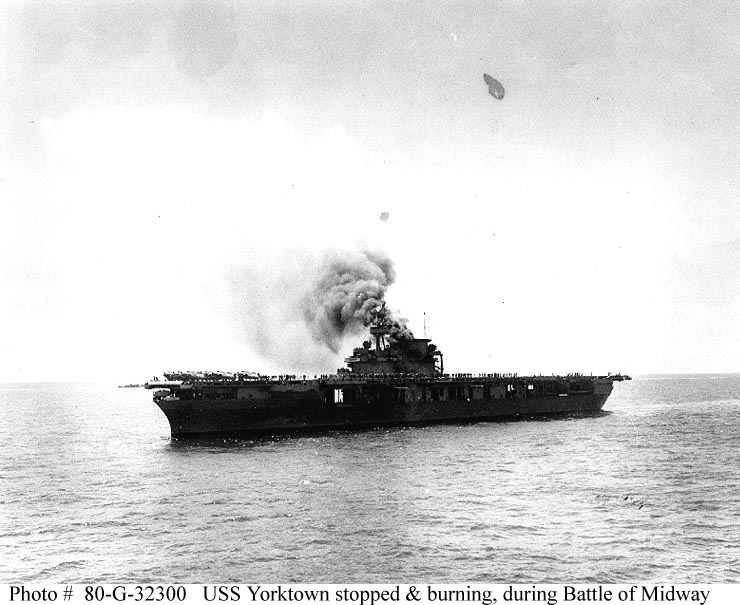
USS Yorktown, June 4, 1942

            The Japanese are now reduced to only one carrier now: Hiryu.  Bombers from that carrier search out the American carriers and find USS Yorktown and attack her.  The Japanese submarine I-168 finishes her off with two torpedoes.
            Aircraft from USS Enterprise and Hornet launch to attack Hiryu, and soon the Japanese have lost all four of the carriers of their main force.  The Americans have lost Yorktown
            In just one day, the tide turns in the Pacific, and from then on, the United States Navy is on the offensive, and the Imperial Japanese Navy will never recover.  There will be three more years of bitter fighting, and many men will be killed and wounded on both sides.  The Battle of Midway was as important in World War II as the Battle of Trafalgar in 1805 when Britain defeated the French and the Spanish fleets.
            Symonds’ Midway is colorful and fast-paced, and his narrative flows with the characters who fought this battle, both the heroes and the others.
            The lessons of Midway for naval officers of our generation were many, and I believe future naval officers will be studying those lessons long into the future.

---


Craig L. Symonds, The Battle of Midway, 2011. New YorkOxford University Press, 452 pp.


Craig Symonds is a brilliant naval historian.  I first met him when he was a professor at the Naval War College and I was an instructor in the naval warfare department.  He continued his career teaching naval history at the U.S. Naval Academy, and was well known for his specialty, the naval side of the Civil War.
Recently Craig retired, then came back to occupy the Naval Heritage Chair at Annapolis, an endowment of the Class of 1957.  My classmates and I from 1957 contributed to endow this chair for our 50th anniversary gift to the Academy, and we’re proud of each of the three fine scholars who have occupied that chair since 2007, and particularly proud of Craig. 

When we arrived at Annapolis and became Plebes in 1953, only 11 years had elapsed since Midway. Among the many bits of naval lore we were expected to spout off whenever asked by an upperclassman was “Kaga, Akagi, Soryu and Hiryu” --- the four Japanese carriers that were sunk at the Battle of Midway.
All during my naval career I felt the proximity of the heroes and key actors of the Battle of Midway.  Several of the flag officers I knew when I was a young submarine officer had served aboard submarines at Midway.
I took command of the destroyer, USS  McCaffery, at Midway in 1972.  We had stopped for refueling before we continued on to Yokosuka, Japan, on our way to take part in the last months of the Viet Nam war.
I relieved Captain Gene Lindsay as Commander of Fleet Activities, Sasebo, Japan.  Gene’s father had commanded one of the ill-fated torpedo bomber squadrons at Midway, and died in that battle.  Sasebo, the base I commanded, when it had belonged to the Imperial Japanese Navy, had been commanded by Admiral ChÅ«ichi Nagumo, the commander of the Carrier Attack Force at the Battle of Midway. He had also commanded the force when it attacked Pearl Harbor.
Early in my tenure at Sasebo I hosted members of the Japanese Diet as we flew aboard USS Carl Vinson for flight demonstrations at sea.  One of those Diet members in 1983 was Minoru Genda, the bright young naval officer who had planned the Japanese naval strike on Pearl Harbor, and then helped plan the Midway operation. I sat next to him as we had lunch with Admiral Sylvester Foley, CINC Pacific Fleet, aboard the carrier.
A lesson from Midway: Let us always keep our Navy ready for the next war. Not the last war, but the next.

Fighters on deck, 1942


The Personal Navigator offers these books and papers about World War II:

United States Naval Institute Proceedings, November, 1942, Vol. 68 No. 477 Annapolis, MD: United States Naval Institute. World War II issue includes excellent photos, including Battle of Midway, June 4-6, 1942, sinking of carrier Yorktown after Midway, aerial view of convoy in South Pacific, , formation of VB-3's, modern Navy fighter, tail marking XF-4F-2, Navy Patrol Bomber by Glenn L. Martin Co., Cruiser USS Memphis.  "The Case for Aircraft-Carrying Oil Tankers" by B. Orchard Lisle. "Fox's Mission to Russia" by Commander L.J. Gulliver, USN (Ret.) writes of Civil War Mission of Assistant Secretary of the Navy Gustavus Vasa Fox to Russia, and of Russian fleet visits to American ports during that war. "The Captain of the 'Whip' Pearl Harbor to Australia" by Lieut. Commander C.A. Ferriter, USN (16 p.). Professional Notes: USS Yorktown. Commander Irving Day Wiltsie, USN, ace aviator and formerly navigator of Yorktown describes the final hours of that ship. Ads for Kollsman, Bethlehem Steel Co., Foote Bros. Gear and Machine, Remler, Kellogg's Cereals, Electric Boat Co., Chicago Wheel & Mfg. Co., New York Shipbuilding Corp., Higgins Industries, Inc., Cramp Shipbuilding Co., Boeing, Douglas Aircraft Co., RCA, Alcoa, Nordberg Mfg. Co., and more. 152 pp. + adv. 17 x 25 cm. Paper periodical, minor nicks and soiling  in cover wrap, very good.     (7901) $28.00. Navy/World War II

United States Naval Institute Proceedings, December, 1942, Vol. 68 No. 478 Church, Albert T., Rear Admiral, USN, Editor. 1942 Annapolis, MD: United States Naval Institute. World War II issue includes excellent Navy photos of Greenland, U.S. Navy ships lost thus far; ships of the Polish Navy, views of the Battle of the Solomon Islands, August 1942. "The Mexican Escuela Naval Militar del Pacifico" by CDR Olin Scoggins, USN. "Three Years of War at Sea" by C.H.Spilman. Total losses for all nations now approach 1,000. Of 14 aircraft carriers sunk, only HMS Glorious was sunk by shellfire. HMS Hermes, USS Lexington and IJN Akagi, Hiryu, Kaga and Ryukaku were all sunk by aircraft. HMS Courageous, Ark Royal, Eagle were lost to submarines, and USS Yorktown and IJN Soryu were both heavily damaged by planes and then sunk by submarines. "Seabees" by CDR. E.J. Spaulding, USNR. Includes several photos of Seabee operations in the Pacific. "Professional Notes" are rich with reports of the War, including reports on submarines, blimps, "submarine slugger", Mosquito fast bombers and new battleships. Ads for Sylvania, Brewster Dive Bombers, Alcoa Aluminum, Consolidated battleships of the air, Inco Nickel Alloys, RCA Mfg. Co., Inc., Cramp Shipbuilding Co., New York Shipbuilding Corp., Sterling Engine Co., more. 154 pp. + adv. 17 x 25 cm. Paper periodical, minor nicks and soiling  in cover wrap, fair. (7919) $28.00. Navy/World War II

Wings for America, Fighting Planes of the U.S.A. by Thomas Penfield, with foreword by Colonel Edgar S. Gorrell, cover illustration by Herbert Rudeen; American Patriot's Series.  ©1941 Chicago, IL: Rand McNally & Co. History of U.S. Military aviation. Numbering system. Pictures of Lockheed P-38, Curtiss SO3C-1, Douglas SBD-1, Consolidated B-24, more; Bombing tactics, Pensacola; U.S. Army Air Corps schools, aerobatics. 64 pp. 14 x 17 cm. Paper on board, cover lightly worn and soiled, text block very good. Overall very good. (5283) $20.00. History/World War II

U.S.S. Bon Homme Richard: Aircraft Carrier Commissioning, November 26, 1944, Navy Yard, New York 1944 New York, NY: Navy Yard, New York. Pamphlet handed out at Commissioning Ceremony; Program of events for Commissioning. History of ship, named after first USS Bon Homme Richard, John Paul Jones' Continental Frigate. In the famous battle with HMS Serapis on 23 Sept. 1779, Serapis was captured, and Bon Homme Richard caught fire .... Commodore Jones, when called upon to surrender, replied "I have just begun to fight."  His ship was lost.  This new carrier cost more than $60 million, or the equivalent of 3,200,000 war bonds of $18.75 denomination. Sponsor for the ship was Mrs. J.S. McCain, wife of Vice Admiral J.S. McCain, one of the Navy's top-ranking aviators.  [The McCains were the grandparents of Senator John McCain of Arizona.] 4 pp. 15 x 20 cm. Paper pamphlet folded with vertical crease. Fair. (7817) $26.00. World War II/History 

Jane's Fighting Ships, 1942 [Issued June 1943] Founded in 1897 by Fred T. Jane, 46th Year of Issue 1943  McMurtrie, Francis E., A.I.N.A., Editor. New York, NY: The MacMillan Co.  Forward to this book notes the tremendous difficulty of preparing this edition, with secrecy on part of combatants and neutrals, efforts to obscure or propagandize, and ships being sunk daily. Frontispiece photo of HMS Exeter, Royal Navy cruiser that bore the brunt of action with the German "pocket battleship" Admiral Graf Spee at the Battle of the Plate on December 13, 1939. Text notes that, while the Graf Spee was scuttled, Exeter was completely refitted and returned to combat. She was sunk by Japanese air attack at the Battle of the Java Sea in 1942. This fascinating real-time record of naval action in World War II shows the ships that survived the Japanese attack on Pearl Harbor (Dec. 7th, 1941), even noting changes to them as result of repairs after the attack. Also with 62 pages of advertising for everything you need to outfit a warship. 582 pp. + 62 pp. adv. 31 x 20 cm. Light blue cloth on board with gilt lettering. Edges worn, tiny white paint spots on cover, good. (6985) $106.00.  Naval/World War II