Tuesday, September 17, 2013

My Life in the Soviet Union....

THE DRY MOUTHED “SPY”


Canal in downtown St. Petersburg, near the Hermitage

            The Day we took the head photographer to Leningrad.   There were many Africans in Moscow, nearly all from Soviet client states in Africa.  In the days we were there, many were at Lumumba University, learning ways to stir up the populace back home in the Congo, or Zaïre, or Angola. Or Uganda, Kenya or Nigeria. Or Sudan or Burkina Faso.
            We had an African-American Air Force Sergeant in our embassy. He was a senior non-commissioned officer who handled our photo lab. He had processed thousands of rolls of film for us back at our Embassy, and we thought he would enjoy visiting Leningrad (now St. Petersburg), this very interesting city in the north, particularly since we had brought back so many rolls of film from here.  He never routinely would travel with us attachés, but our General thought it would be good for him to see what it was that we were shooting.

            But when the KGB saw us with a black man in our car, they went nuts.  They acted as if we had brought a secret weapon to Leningrad.
            They normally would follow our car with a car full of stolid, sullen, very husky young men.  We called them goons.  But this day, they had four cars, switching off amongst one another. Loaded with goons.  These cars were all Soviet Zhigulis, the Russian version of the Fiat, made in a huge factory built with the help of the Italian Fiat company in a city named Tolyatti (after Italian Communist Togliatti) several hundred miles southeast of Moscow.
            Often I would make notes about what I wanted to observe on our drive that day, and I would write these on water-soluble rice paper, which I could easily pop in my mouth if we should be apprehended. This special paper would dissolve at once.
            When, with the four cars of goons following us I thought we would get hauled out, I decided it was time to swallow my notes.  However, when you are scared, which I was, your mouth dries up so much that you can’t even dissolve the paper.
            We were driving next to one of the many canals that run through Leningrad, and since our surveillance was not in sight at the moment, I thought it would be a good time to stop and throw the mouthful of rice paper in the canal.  I think it was the Griboyedova Canal.
            Wrong!  As I should have suspected in icy, frozen Leningrad, there was just ice in the canal.  Foiled! My mouthful of paper just rested on the ice.
            I was lucky that the KGB didn’t find the rice paper. At any rate, we never got apprehended.   The Sergeant had a good ride around town.
            I would make a lousy spy.

 Peter and Paul Fortress, from across the Neva


Women’s Day in Leningrad—Fats took the day off!
                We took the Midnight Red Arrow from Moscow to Leningrad, arriving on schedule at 8:25 a.m. A driver met us at the train station and drove us to the American Consulate, where we stowed our bags and jumped into our car, all set for a day of work.
            One of the things we did a lot was "Order-of-Battle".  We had to report ships in port, including boats and ships that just moved around the canals and rivers of the USSR. The information we provided was correlated with information from agents, from satellite imagery, and electronic intelligence intercept to maintain a picture of the Naval Order of Battle of the USSR.  This meant taking a lot of long, long walks in some pretty crappy, snowy places.          
One of our favorite walks was along the Neva River at Schmidt’s Bank, in Leningrad.  Here hundreds of boats and often warships and submarines tied up.  Many of the smaller, lighter draft boats were awaiting a schedule to move up the canals that cut across Russia. Here we could see these boats and ships, and Red Fleet ships, and also ships under construction in the many shipyards of Leningrad. 
            Whenever we would take these walks, we tried to take along our cameras and collect photos of interesting things.  Photography in this area was forbidden, however.
            The KGB assigned an elderly “goon” that attachés over the years had named “Fats.”  He and some of his associates generally were around to follow us wherever we walked, or drove, and to make our job harder, or impossible.  They wore the red armbands of “Druzhniki,” or “concerned citizens.”  Sort of like elderly volunteers who operate as school crossing guards, except these were assigned to look after the foreign “spies.”  The Soviets considered all foreign diplomats spies—they hadn’t changed their attitude toward foreigners in centuries.
            One day, March the 8th, 1983 to be exact, it was International Women’s Day. Now, in fact, the Soviets didn’t give much of a hoot about women’s rights, except the right of old women to stand in the street all day long in the winter, smashing ice with a heavy iron rod.
            But this day, as we arrived to do our job of collecting intelligence in Leningrad, there was NO KGB.  They had the day off!
            I was traveling with my assistant, Pierce Crabtree, a big, burly former Navy football player. With no KGB to bother us, we went wild photographing shipyards and ships and everything we could see.  We were driving a Soviet version of a Land Rover, called a “Niva.”  We thought this would be a great day to check out some radar installations near the Czars’ summer palace at Petrodvorets.  However, somewhere between Kipen’ and Ropsha, we got stuck in the snow. 
            If the KGB had been around, we would not have been able to get that far.  Now, free to travel, we had gone and gotten ourselves in trouble.  The snow was pretty deep.
Fortunately, along came a bus full of Russians.  The driver and some of the passengers got out and helped push us out of the snowbank. 
It was just another example of how friendly the Russians were, except for those whose job was to keep an eye on us.
 [An earlier version of this was published August 16, 2011.]

Now for some books and papers from The Personal Navigator:


The Locks – Charles River Dam, from Boston, Its Byways & Highways

Boston, Its Byways & Highways, Being Twenty-five Drawings Reproduced in Photogravure by John Albert Seaford ca. 1916 Boston, MA           Le Roy Phillips, Publisher. 24 plates. 13 x 20 cm. Elegant drawings of Boston sights on 7.8 x 10.4 cm. plates tipped in with descriptions. Includes Cover, with drawing of State House, Bulfinch Front; Pemberton Square; Trinity Church; From Adams Square to Faneuil Hall; Towers of Cambridge Bridge; Temple Street and the Bulfinch Dome; Roll Lift Bridge at Fort Point Channel; Market District; The Locks--Charles River Dam; more. Heavy cardboard with paper wraps, cover moderately worn. Individual plates and text block very good. Fair. (4784) $14.00. Travel

Boston Almanac 1853 

Boston Almanac For The Year 1853 with fold-out map of Boston 1853 Boston, MA: Damrell & Moore, and George Coolidge. 188 pp. 8 x 13 cm. Lists businesses, national, state and local leaders. Excellent engravings of local sights. Fifteen page article "Ancient and Modern Boston" by D. J.V.C. Smith compares Boston of 1722 (shown in map) with today (1853). Plans are in works to fill in the whole of Back Baybetween Roxbury Mill Dam and the Neck. He predicts that South Boston is "predestined to be the magnificent section of the city, in respect to costly residences, fashionable society and the influence of wealth. Monody to Daniel Webster, who died Oct. 24, 1852. Very interesting ads for ink, removers, carpeting, plumbers, tea, curriers. shell combs, cutlery and more.  Fold-out map of Boston includes Map of Town of Boston in New England by Capt. John Bonner, 1722, engraved for Boston Almanac 1853, and detailed New Map of Boston Comprising the Whole city with the new boundaries of the Wards, 1853.  Map shows Receiving Basin adjacent to Public Garden, South Bay between Albany St. and South Boston. Inset map of East Boston.   Cloth on board with gold printing and blind-stamped design. Back cover spine broken,  Map worn, small tears in folds, fair. Overall fair condition.    (8173) $68.00. Reference       
  

Roosevelt: State of New York in Memoriam Theodore Roosevelt Born: October 27, 1858  Died: January 6, 1919 1919 Albany, NY: Legislature of the State of New York. 131 pp.          18 x 25.5 cm.            Marvelous tribute to a towering figure of America in the last years of the 19th and the first years of the 20th century. Includes much biographical detail, excerpts from TR's speeches, including last public words about promoting Americanism, and speech in which he publicly accused the Legislature, of which he was member, of corruption in Manhattan Elevated Railroad affair. Includes Address by Sen.Henry Cabot Lodge of Massachusetts, his lifelong friend, before Congress on Sunday, February 9, 1919. Black cloth on board with gilt printing on cover and spine. Small biopredation holes in cover. On ffep stamped "Compliments of William Duggan, Senator 19th District" Very good.  (2350) $34.00. Biography/History                                                            

Soviet Theatre ca. 1950 Moscow, USSR. Collection of photos of Soviet theatre performances of 1950s, including actors Y. Tolubeyev, Z. Kirienko, A. Shatov, G. Stepanova, G. Menglet, V. Lepko, A. Kruglov, V. Orlova, T. Samoilova, R. Nifontova, V. Pashennaya and A. Katsynsky; Ballerina Galina Ulanova as Juliet, Yuri Zhdanov as Romeo. 26 pp. 27 x 18 cm. (5695) $15.00. Travel/Educational

Rockport, MA: Ye Headlands of Cape Ann-- Real Estate Advertisement by Giles, Jason 1902 Rockport, MA: The Rockport Review. 32 pp. 23 x 15 cm. Booklet tells history of Rockport as it offers a parcel at the Headlands of theNorwood property.  Property is served by water and electric lights, with an easy walk of eight minutes to stores, markets and post office, and in ten minutes, to the B. & M. R.R. railway station.  Booklet shows the beginnings of granite breakwater in harbor, intended to provide 'Harbor of Refuge' for the North Atlantic Squadron of U.S. Navy war vessels during the summer months.  Photos of local sights, including two page spread showing photo of town and harbor, taken from belfry of the Congregational Church. Paper booklet, very good. (7282) $59.00. Travel/History


                                                                                                                                                                                                Contact me at scoulbourn1@verizon.net


Saturday, September 14, 2013

To the Outer Banks

Our Trip to the Outer Banks of North Carolina
Sept, 20-25, 2004


Left to right, Paul and Pat Brown, Sam and Marty Coulbourn

                A while back we drove down to Fairfax, Virginia to join some old friends for a trip to their favorite destination, the Outer Banks of North Carolina.
            We first met the Browns when he was an Army lieutenant colonel and I was celebrating my promotion to that same rank in the Navy, commander.  We were stationed in Iran at the time. Paul drew on his armored cavalry experience in the U.S. Army as he advised the Iranian Ground Forces, and I operated from my background in submarines and destroyers to help advise the Iranian General Staff on long-range planning.  
            Advising Iranian officers on long-range planning was a bit of a problem, because the Shah had a habit of hearing someone brief him on what his forces could look like in five years, and he would say, “Right—let’s have that—NOW!”  
            Not even the best army in the world could build itself up that way.  The idea of long-range planning was to work out the kinds of people you wanted to enlist in the Army, the equipment you had to buy, the schools you had to build, and so on.  You did some things this year, some the next, and so on.  Even with all the oil money the Shah was receiving, you couldn't have sailors, airmen, planes, air strips, ships and ports instantly!
            This was in 1972.  Little did the Shah know then that in seven years, he would be gone.

            But back to Paul and Pat.  Patricia was a pretty brunette who had married Paul right after he graduated from West Point in 1951.  
            Since we left Iran we’ve gotten together with the Browns to visit a lot of places along the eastern seaboard of the United States.
            Paul Brown was the son of an old Virginia Judge, and they lived on a part of the Judge’s old estate in Burke, Virginia.  The family homestead was reputed to have a Confederate soldier as a ghost clattering around in the upper floors, and since the home had been on the main road to and from Bull Run, someone was always finding an old Confederate or Yankee bullet or belt buckle, or some other memento of the Civil War. 

After a nice breakfast we departed in Paul Brown’s ten-year-old Ford Explorer, with four-wheel drive.  He had recently had the car detailed, and the engine cleaned, which somehow screwed up the ignition connection, so he had to use a screwdriver under the hood to jump start the car every time he wanted to get it running.

We stopped for lunch at a favorite place of the Browns’ in Williamsburg, VA.  I had some form of quesadilla which threatened to stay with me for a long time.  We drove past Norfolk and Virginia Beach and then into North Carolina, heading east to cross onto the Outer Banks north of Kitty Hawk.  We arrived at our destination, a hotel that made an attempt at Elizabethan décor, in Manteo, NC.  Manteo, on Roanoke Island, is the site of the Lost Colony.  Although it is still lost long after Sir Walter Raleigh left it to languish four centuries ago, the local folks seem to make it the center of their commercial enterprise.


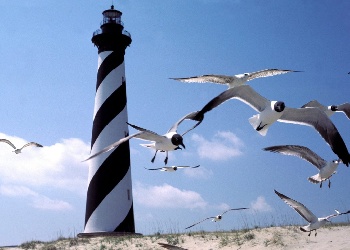
Cape Hatteras Lighthouse

            We left Manteo and drove to the Outer Banks and Ocracoke. We drove down along the string of islands in North Carolina that form the barrier against the Atlantic Ocean.  We arrived at Cape Hatteras, the ferry landing where we awaited our ferry that would take us across the inlet to Pamlico Sound, to Okracoke Island.

Because of the problem with Paul’s car, he got out to jump start it, and when it started he had left it in gear and it started easing forward toward the end of the pier, with the three of us in it.  I fumbled for the gear shift, and was able to shift to neutral just before we (1) smashed the ticket taker’s booth, and (2) plunged into Pamlico Sound.
It took us a few moments to realize that three of us nearly drowned that day!

Leaving Hatteras for Okracoke

            When we finally boarded the ferry at Cape Hatteras for Ocracoke, Paul was afraid the Explorer might not start again if he turned it off, so he wanted to let the engine run as the ferry chugged 40 minutes across Hatteras Inlet between islands.  The ferry personnel, who had seen how Paul had nearly killed them at the landing, were not about to let him do that.  They made him turn off the engine.
            We managed to drive off the ferry without any more dramatics, and spent the night at the Castle Inn in Ocracoke. Then we drove to Hatteras and stayed at an inn near Hatteras Light. We drove onto the beach, which requires letting a lot of the air out of your tires, and then we tried a little fishing.  This was what Paul was anxious to show us— the beauty of the beach at Hatteras, on the North Carolina Outer Banks.  We stayed on the beach and watched the sun set.
            We didn’t catch any fish.  However since we managed to keep from drowning at the ferry landing, we figured we had had a pretty good time. Somehow we managed to get the tires re-inflated.

Here are some books and papers for your consideration…

New England Economical Housekeeper title page

New England Economical Housekeeper, and Family Receipt Book, The, Stereotype Edition [Second Edition]  by Mrs. E.A. (Esther Allen) Howland.   1846 Worcester, MA: S.A. Howland.  Little book provides New England housekeepers with recipes for scores of dishes, then in Medicinal Department, guidance for asthma, bleeding at the nose, burns and scalds, salve for a burn, sore mouth, dysentery, diarrhœa, consumption, corns and more.  Menu for Thanksgiving Dinner: Roast Turkey, stuffed; a pair of chickens, stuffed and boiled, with cabbage and a piece of lean pork; chicken pie, potatoes, turnip sauce, squash, onions, gravy and gravy sauce, cranberry sauce, oyster sauce, plum and plain pudding, with sweet sauce; mince, pumpkin and apple pies. Recipes include Dyspepsia Bread, Rice Bread, Johnny-Cake, Temperance Cakes, Mutton Pie, Indian Pudding, Boiled Calf's Head and Pluck  (tongue, heart, liver, brains); Mutton with Oysters; Indian Gruel, Sassafras Mead, many more.  Also inserted in book are ten+ handwritten recipes for Fruit Cake, Sweet Pickles, Cure for Dysentery, Pork Cake, Pickling Beef, Lemon Pie, Blood Syrup, more.  Also list of those who died in Winchendon (MA) in January, 1875. Excellent little glimpse into New England life in the Nineteenth Century. Frontispiece illustration of two women in kitchen. 108 pp. 10.5 x 18 cm. Paper on board with cloth tape spine; spine worn and frayed. 12+ handwritten recipes and notes and one 1875 newspaper clipping with recipes  inserted.  Book binding cracked, fair. (8099) $102.00. Cookbooks/Ephemera

Family Companion, The; Containing Many Hundred Rare and Useful Receipts, on Every Branch of Domestic Economy; Second Edition by J.R. Wells,  M.D. 1846 Boston, MA: J.R. Wells, M.D. Recipes for making tea, coffee (with shavings of isinglass or dried fish-skin); how to boil a calf's head; cures for apoplexy, cancer (carrot poultice), ear ache (a roasted onion in the ear), dropsy, bleeding lungs (eat salt); tips on boiling molasses; Cheap paint for a barn; how to preserve potatoes till spring; how to destroy bed bugs, rats, mice; how to remove stains from Broadcloths; Directions for washing calicoes; To keep moths out of carpets, sprinkle tobacco or black pepper on the floor before you put the carpet down. 72 pp. 11.4 x 18.2 cm. Paper booklet binding carefully hand stitched, original blue paper cover replaced by a later cardboard cover, pages foxed, poor. (5981)  $27.00. Cooking/Medical


World's Fair Souvenir Coupon! 1894 Chicago, IL: American Cereal Co. Advertising booklet includes souvenir coupon for FREE complete set (12 pictures) of our beautiful panorama, "The Procession of the Seasons" as it was shown at the World's Fair. Ad for Pettijohn's California Breakfast Food. Back cover, full-color ad for Quaker Rolled White Oats. Letter to the American Housewife introduces this small cookbook.   How to cook cereals.   Recipes for Quaker Breakfast Porridge, Fried Pudding, Griddle Cakes, Quaker Oats Rolls, Quaker Oats gruel, Quaker Buckwheat Cakes, Quaker biscuits, breakfast gems, plantation gems, waffles, crullers and doughnuts, "F S" Rolled or Cracked Wheat, Cracked Wheat Blanc-Mange, Farina Ice Cream, Johnny Cake, Southern Batter-Bread. centerfold features full-color pictures of eight "F S" products 68 pp. 11.5 x 17 cm. Paper booklet, cover soiled, small chip in lower left front corner, closed tear in back cover, 2 x 2 cm  chip missing from lower left corner of back cover. Fair. (7260) $20.00. Cookbooks/Advertising


Eating the Russian Way, by Gould-Marks, Beryl, illustrated by Geoffrey Walker, first edition 1964 New York, NY: Holt, Rinehart and Winston, Inc. Rich collection of Russian recipes--Blini, Tvorozhniki, several kinds of Borsch, Shchi, Okroshka, Pelmeni, Hussars' Roast, and many more. 128 pp. 13 x 19 cm. Black cloth on board with gilt decoration. Very good. (3235) $20.00. Cookbooks/Russian

White House Cook Book, a Selection of Choice Recipes original and selected, during a period of 40 years' Practical Housekeeping by Mrs. F.L. Gillette,  1889. New York, NY: J.A. Hill & Co. This edition features frontispiece engraving of Frances Folsom Cleveland, the Bride of the White House, and photograph of Connie Scott Harrison. Guidance on carving, dinner-giving, table etiquette. Recipes include Mulligatawny Soup, Fried Eels, Oyster Fritters, Duck Pie, Tripe Lyonaise, Baked Calf's Head [Probably not a popular dish in these days of concern about Mad Cow]; Gooseberry catsup, Corn Dodgers, Green Tomato Pie, more. How to cure bad breath, dye hair, remove freckles; ox-marrow pomade for the hair. Includes pictures of previous first ladies. Dark gray cloth on board, minor soiling, edges rubbed, inside front hinge cracked,  521 pp. 19 x 25 cm. Very good. (2996) $36.00. Cookbooks/Presidents' wives

Elegant Extracts of Natural History; Collected and Revised frin a great variety of the most elegant and authentic writers in this Science, with a Preface on Education by Robert Heron. Volume 1 only. By Buffon, Thomas Jefferson, et al. 1792  Edinburgh, Scotland: E. Balfour. 494 pp. 13.5 x 21.4 cm. This is an interesting and unique approach to explaining natural history, employing known authorities on various topics and engaging in a bantering family dialogue to teach astronomy. In the Section on the Human Species there is a 12 page discussion on the development of young Mozart, by Daines Barrington; a section on Dwarfs, Giants, and 20 pages on Slavery, by Clarkson. Also in the Human Species are segments on abstinence, sleep, hunger, and the Orang-outang. There is a section on Quadrupeds, which discusses, inter alia, Chamoy, the Goat, the Rein-deer, the Giraffe or Camelopard, Tygers, written by d'Obsonville, the Glutton, the Sloth and the Seal, Sea Lion by Buffon and Leming, by Goldsmith.  There are no illustrations. Calf on board, decorated spine, exterior hinges cracked, moderate wear overall, .5 cm. at toe of spine missing. Interior tight and clean. Contemporary inscription on title page  “John Ward". There are no illustrations. Very good.   (8322)  $65.00.   Scientific/Natural History

Cyclopædia of Wit and Humor, The; Containing choice and characteristic selections from the writings of the most eminent humorists of America, Ireland, Scotland, and England, Ilustrated with 24 portraits on steel, and many hundred wood engravings, 2 Volumes;  Burton, William E., Editor;  1858 New York, NY: D. Appleton & Co. 1136 pp. 17 x 25.5 cm. Here is a rich collection of the humor of English-speaking people up to its publishing date of 1858. Droll stories, poems, songs by American and Irish writers and speakers in Vol. I and Scottish and English writers and speakers in Vol. II. .  Beautifully illustrated with 24 steel engravings of notable humorists, all with tissue guards.  Two volumes, quarter leather with marbled boards, marbled page ends, five-ribbed spines with gilt titles. Minor rubbing to leather spines, altogether very good copies. ( 8330) $150.00.  Humor                

 Loves and Heroines of the Poets Stoddard, Richard Henry, editor 1861      New York, NY: Derby & Jackson, Broadway.       480 pp. 19.5 x 28 cm.  An elegant volume of specimens of English love-poetry, that which is, or seems to be, addressed to particular women. Begins with Dante Alighieri, Francesco Petrarch and Torquato Tasso, then Sir Thomas Wyatt, Henry Howard, Damuel Daniel, Edmund Spenser, William Shakespeare, Ben Jonson, Percy Bysshe Shelley, Lord Byron, Charles Wolfe, George Darley, Alfred Tennyson, Bryan Waller Proctor, Henry Wadsworth Longfellow, John Greenleaf Whittier, Coventry Patmore, and many more. Splendid full leather volume with richly blindstamped design front and back with embossed gilt title, five ribs on spine, elegant gilt cloth inside pastedowns and gilt-edged pages. Minor scuffing of spine and edges of cover. Very good. (8318) $70.00.  Poetry


Monday, July 22, 2013

Visit to a real old country auction


Both feet into the past…..
This old Walker & Pratt cook stove went for $100.  Women up here baked their biscuits in this oven in the early 1900s.  You can buy a refurbished stove like this for $4000.


            At my age, I’m sure most younger people think I’m really anchored in the past, but Marty and I took a real trip back to an earlier, quieter time last weekend, and we only drove about 100 miles!
            Hillsborough is a beautiful little town in south central New Hampshire, nestled high in the hills, near Pack Monadnock  and Mount Monadnock.
            If you approach it from Concord, or from Weare, NH, you enter a town that looks pretty much the same as in the 1940s.  There’s an old tenement, with about four floors of rooms for low-paid mill workers, perched right next to the Contoocook River.  Downtown is a string of businesses that look so untouched by time you start to think you are on a movie set.  Drive further, and you return to 2013, with modern service stations, Dunkin’ Donuts, and the rest.
            We went to a country auction, held by a New Hampshire auction firm called Wigsten Associates, and it was really country.  No telephone or internet bids, no computers helping keep the tally of bids.  
            The auction was held on a farm on Bear Mountain, and to get there we drove on roads that got narrower and steeper as we got closer, with magnificent views of the countryside, and the elegant, green mountains. 
            We passed several beautiful farms, with contented-looking cows taking in the cool Sunday morning air. 

Crowd came to buy tools, lawnmowers, tractors and antiques.


            At the farm we could see the big striped tent that told us we had found the auction.  Everything on this farm will be sold shortly, including a very stately homestead, built in the late 17th century, but obviously very much up to date. 
            At the auction they were selling a Farmall tractor, several automobiles, all kinds of new and nearly new equipment like a hydraulic log splitter, and everything you need to overhaul a car, or a tractor.  There were about eight riding lawn-mowers, and a World War II era Jeep with license plates from Andrews Air Force Base in Maryland. There was a huge hose reel on wheels, just the thing to take to fires in the days before fire engines.

All this old buggy needs is a horse.


            There was an old buggy, and the kind of sled you would have used to haul your ice-fishing gear across a frozen New Hampshire lake back in the 19th century.  There were 18th and 19th century farm tools and kitchen equipment, and there were neatly packaged large plastic bins filled with everything a packrat or a hoarder could imagine, including kitchen tiles, a roll of copper for flashing, drain pipes of every size, tools of all sorts, old pictures, boxes of letters from the 19th century, and a complete set of modern equipment from a professional photographic studio. 
            This auction brought loads of good old boys from the neighboring farms, eager to scoop up the tools, the tractors and whatever else. It brought antique automobile fans to look over the 1971 Ford LTD convertible or the Jeeps.  It brought antique dealers, like Marty, anxious to buy interesting items from a forgotten age, so hard to find these days.  And it brought other bargain hunters of all stripes and sizes.
            An event like this draws a portion of people who look very much as if they had just come out of winter hibernation, including young men and women who seem to think that it is all right to eat until you’re bloated, and then cover all the extra skin with tattoos.


This 1971 Ford LTD convertible drew lots of lookers, but here only the man with the white beard is admiring that eight-cylinder 429-c.i.d. powerhouse.   Men at left are gathered around a relatively new military Jeep.
Man with feather in his hat is an antique dealer from New York State.


This family came to buy, and they did indeed.

            The antiques that fascinated us were genuine, Made-in-the-USA goods:  Old 18th century candle stands, different pieces of equipment for cooking at an open hearth, a large brass trivet for keeping things warm near the open fireplace, loads of old snowshoes and sleds, 18th century hay rakes, a Victorian candle reflector, and much more.
            Murray Wigsten heads this auction firm, based in nearby Weare, NH.  It was indeed fascinating to watch the teamwork of this all-family operation.   

            Two more generations of Wigstens take the auction business seriously.

            Murray did most of the auctioneering, but his son stepped in (see photo above) to spell him, ably assisted by four children, including this sprite of a little girl, here showing bidders a toy vacuum cleaner.  All four kids did a tremendously energetic, enthusiastic and devoted job of helping show the goods and then delivered items to winning bidders.   One young boy, no older than 10 or 11, drove the riding lawn mowers, one after another, into position to sell, and he wasn’t joy riding—he was a serious worker.
            Call me old-fashioned, but it was really fun to step back and spend a few hours in old America.


Wednesday, July 17, 2013

Navy Comes to Rockport

The Navy Comes to Rockport, 2013


Three Naval Academy Sailboats visit Rockport July 12-14, 2013

Three 42-ft. Yachts of the Naval Academy Sailing Squadron visited Rockport this past weekend, as did sailors from Portsmouth, NH and Newport, RI, and the town rolled out the welcome mat for them. 
            Roger Lesch, a retired local police officer, and Sharon Grandmaison, who runs a child care service, are the driving force behind the Rockport Navy Committee, which also includes people connected to the American Legion, local fishermen, the Sandy Bay Yacht Club, the Rockport Country Club, Navy veterans, friends of the Navy and old Naval Academy graduates who live here. 
            It is fascinating to see how Rockporters, and visitors, are attracted to these sharp young men and women sailors and Midshipmen.
            
            While the Navy was in town, we took turns standing “watch” down on T Wharf where one of the boats was open for visitors.  Visitors to Rockport strolled down the wharf to look at all the boats, and we offered them a chance to visit the Naval Academy yacht. 
            They’re usually eager to do it, and clamber down the gangplank and lift themselves on board. 
             The Rockport Navy Committee had a whole schedule for these 30 Midshipmen and their advisors, including volleyball and softball games, cookouts, a lobster feed, breakfasts at the First Baptist Church and at Brackett's, and many local merchants and citizens helped offer Rockport's hospitality.
            The Navy Committee has done this for visiting warship crews in recent years, as well.

Northeast Regional Navy Pops Ensemble as they play a New Orleans jazz number

            Roger and Sharon always do a spectacular job of organizing all the events of the Navy Weekend, and this means getting families to sign up to house the midshipmen and sailors, and organizing for feeding all these hungry young people, including a lot of lobsters. 
            This year the Northeast Regional Navy Pops Ensemble came, and Roger and Sharon set up to give them all a fine lobster dinner before they played. 
            The band with some 38 members, is a brilliantly professional organization, based at the Naval War College in Newport, RI.  It amazed me how, on a hot summer day, these musicians appear in perfect, spotless and crisply ironed white uniforms.


USNA Adult Advisor shows visitors Academy Yacht

            When I had my "watch" on T-Wharf last weekend, Advisor and Skipper Hight Spencer, an adult with more time under canvas than most naval officers, joined two of his  Midshipmen crewmen to show off their boat, and they showed off the cramped spaces for ten midshipmen aboard the boat, and usually there was a conversation about life at the Academy, and the Navy. 
            It’s interesting to talk with visitors to Rockport, and Rockporters, who stroll down and go aboard the Navy sailboats.  They come from all over the world.

USNA boat at sea

            Summer cruises at the Academy have always been very serious training events, with a little time squeezed in for the Mids to see new lands and meet new people. 
Midshipmen spend their first summer at the Academy learning about the Navy, and getting ready for four years of rigorous physical and academic life.  From the day that they are sworn in, their lives are a continuous whirlwind of marching drills, obstacle courses, trips to the rifle range, swimming tests, whaleboat rowing, academic work, running, hiking, sports, more marching, and lots of sweating. 
            The second summer is such a relief, because Plebe year, and all the harassment and questions and drilling and memorizing, sitting on an invisible stool at meals, and other forms of “character building” are done.  The year of academics is done, and it is time to go to sea.
            Today, some Midshipmen spend part of that summer in these 42-foot sailboats, and they practice navigation, and learn the finer points of handling a real sailing craft for several weeks.  After that, they’ll fly to some base in the United States or overseas, and embark in a submarine or surface warship for several weeks. 
            On that ship they’ll learn what enlisted men and women do that makes the ship operate and able to fight.  They’ll learn how to make torpedoes or missiles ready for firing, how to stand deck or diving station watches, how to inspect tanks, how to charge batteries on a submarine, how to fuel ship, how to navigate, and how to clean a head (crew’s toilets).  This cruise as sophomores or “Youngsters” is intended for them to get to see the Navy from the point of view of enlisted men and women.  The next times they go to sea they’ll be studying the role of officers.
            That “Youngster Cruise” of 2013 is not much changed from the one we took aboard a battleship in 1954.  (At least, from my point of view!)
            As soon as the graduating class had received their commissions and diplomas, we boarded troop transports from Annapolis down to Norfolk, where we embarked in a summer training squadron.  My ship was USS New Jersey (BB62), a 45,000 ton behemoth, with nine big 16-inch guns.

Four Battleships Rendezvous off Norfolk, June 1954

            As soon as we were aboard, we sailed out of Norfolk and rendezvoused with three other battleships.  The photo above shows that event, which was the last time those marvelous veterans of World War II ever sailed together.  Besides New Jersey, there were the Battleships Iowa, Wisconsin and Missouri.  Missouri bore a large nameplate that marked the location on her deck that had been the place for the signing of surrender documents by the Empire of Japan that marked the end of World War II.
            When this historic event was over, New Jersey and Missouri, two cruisers, many destroyers, a small carrier, and some auxiliary ships, started our way across the Atlantic. 
            All the way across we worked, and studied, stood watches, and worked at the jobs usually designed for enlisted men, like cleaning compartments and washrooms, painting, loading stores, assisting in taking on fuel, and much, much more. 
            The Jersey crew had just returned from duty off Korea in the Korean War, firing those big guns at North Korean targets. 
            In the evening there were movies topside on deck, and once on the cruise a “Smoker” when men gathered on the large teak deck aft, the fantail, to watch boxing matches between sailors, or between midshipmen.
Crew toilets in battleships resembled the bottom half of a large pipe, or trough. Sailors sat on toilet seats across this half pipe, and sea water flowed through the pipe, and then carried the waste overboard.  At busy times, there might be a dozen or more sailors all sitting on this half pipe.
At some time or other, a wise guy would take a wadded up newspaper and set it afire, and let it float in the halfpipe, upstream of the men sitting there.  You can imagine the surprise as the fire passed beneath the bottom of each man, and each popped up, in sequence.

Holystoning

            Each Saturday at sea was Field Day, with meticulous scrubbing from stem to stern, and midshipmen learned how to holystone.  This was a long-observed job of lining up sailors, barefoot, on the teak decks of the battleship and scrubbing those decks with soapy water until they shone.  The device for scrubbing was a mop handle stuck in the hole of a boiler fire brick.  In a row of Mids, we rubbed the brick back and forth on the deck, sliding and sloshing in the soapsuds, until a senior Chief Petty Officer decided the deck was sparkling clean.  Here’s a video of sailors holystoning the decks of USS Missouri:

After about two weeks of this life at sea, the ships arrived at their first liberty port, and ours was Vigo, on the northwest (Atlantic) coast of Spain. 
            This part of Spain, just nine years after World War II ended, was really poor. Many of the people who came to see our ship come alongside the pier and tie up were barefoot.
            They were poor, but Spaniards showed the sailors and midshipmen aboard the battleship and other ships a marvelous welcome, with dancing in the streets, a street fair, and loads of booths selling all kinds of Spanish food and drink.  I recall a bottle of Spanish “champagne” sold for about one U.S. dollar. 
            We had tours of the town, and trips just a few miles north to the very picturesque and historical city of Santiago de Compostela.

            Our next port was Cherbourg, France, and there the battleship anchored out, and we took ferries to go ashore.  The liberty boats returning sailors and midshipmen to the battleship after an evening in the town could be interesting.
            I grew up in a non-drinking home in Texas, and I had not really been exposed to people who routinely got very drunk and fought with each other, using fists, feet, knives and firearms to maim and kill each other. 
            Battleships were big in every way, and with a complement of 2000 officers and men, there were always a few troublemakers. 
            The Cherbourg liberty boat was really a large ferry that could carry over 200 men, and one evening I was aboard along with a whole load of enlisted men and midshipmen, and some were really drunk.  One rather small, wiry sailor was incredibly drunk, and started picking fights and then picked a fight with a large sailor who was a Shore Patrolman.  The S.P. started to restrain the sailor, who then summoned up the superhuman power only available to drunks, and swung the huge shore patrolmen around the deck like a limp rag.  Then, more shore patrolmen showed up, and soon there must have been a dozen sailors wheeling around, trying to restrain this little drunken man. When they finally had him down, a hospital corpsman appeared and gave the man an injection of something to quiet him down.
            I’ve seen spectacular drunks quite a few times in my thirty-four years in the Navy, but that was my introduction.
            Ashore in Cherbourg, ten years after the D-Day Invasion there against bitter Nazi opposition, there were still signs of bomb and artillery damage, and graffiti about the then current war of French troops fighting at Dienbienphu, in French Indo-China.
            After a wonderful trip to Paris, we were all back aboard New Jersey, and then sailed to Guantanamo, Cuba, where we had a chance to fire those big 16-inch guns and experience life in boiler rooms when the temperature reaches 130 degrees F. or more.
           [NOTE: This Blog first appeared in July, 2011.  It has been updated for this Navy visit.]


Contact me at scoulbourn1@verizon.net